The operating principle
A Reel usually goes viral when the hook, the middle, and the payoff all align around one clear audience outcome. Treat virality like a system to engineer and diagnose, not a mystery to hope for.
If you want to know how to make a Reel go viral, ignore most checklist advice.
“Use trending audio.” “Post at the right time.” “Add hashtags.” Those things can help at the edges, but they do not explain why one Instagram Reel keeps spreading while another stalls after an early burst.
Viral Reels usually win because they do four jobs in order:
That last point matters more than many creators admit. Reach without fit is weak proof. If a Reel gets views but drives no useful comments, no saves, no profile interest, and no downstream conversion quality, it may be entertaining, but it is not a strong growth asset.
This guide is a practical system for making Instagram Reels that travel. It is built for operators: creators, social teams, founders, and performance marketers who want repeatable patterns, not one lucky post.
A lot of Reels do fine for a few minutes or a few hours, then flatten. That usually happens because the content looked promising enough to earn initial testing, but not strong enough to keep expanding into non-follower reach.
The most common failure modes are simple:
This is why “better production” alone rarely fixes short-form performance. Instagram does not distribute Reels because they look expensive. It distributes Reels that create attention loops and social proof.
If you want broader context on how that works across platforms, pair this guide with how to make a video go viral and short-form video trends.
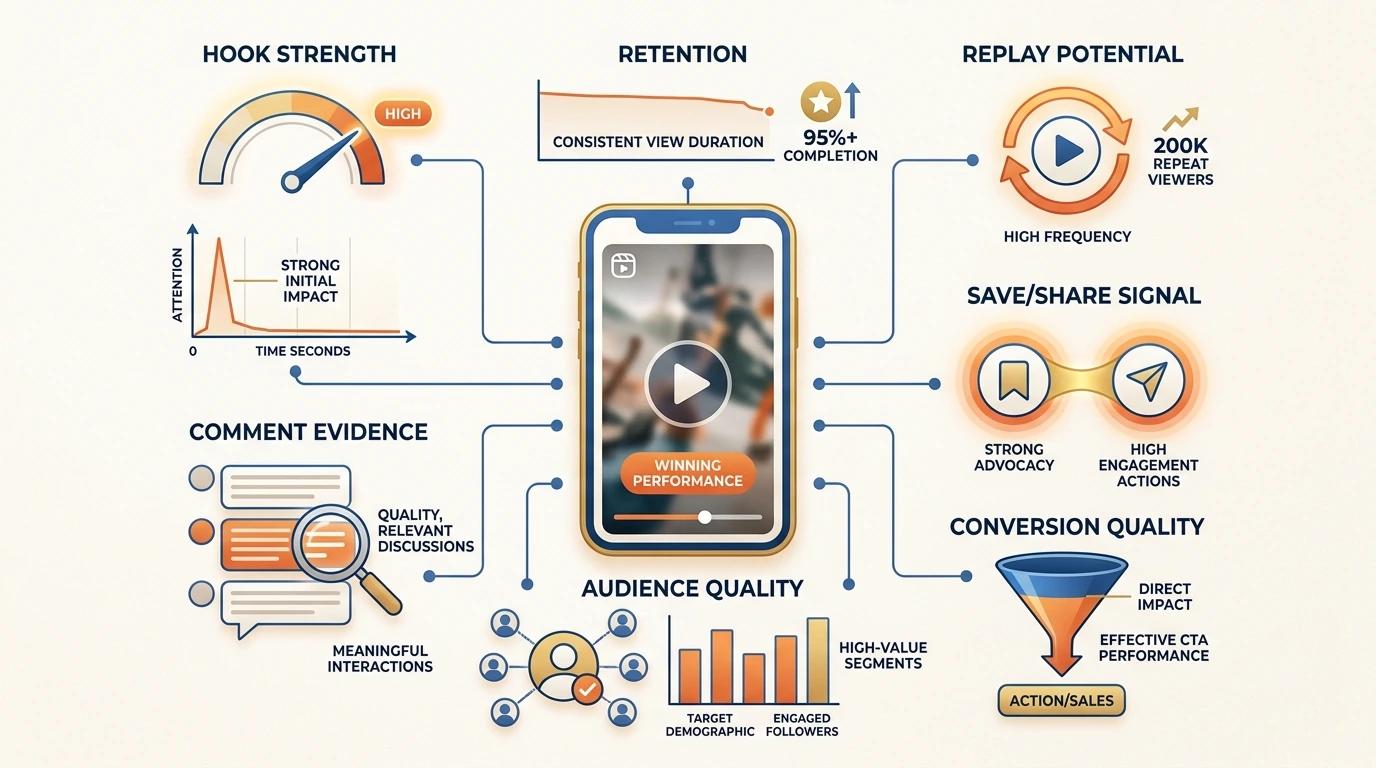
Instagram is not rewarding “creativity” in the abstract. It is rewarding viewer behavior.
In practice, strong Reels tend to show some combination of:
Comments are especially useful as diagnostic evidence.
A crowded comment section full of “needed this,” “sending this to my team,” “where did you find this,” “part 2 please,” or specific objections tells you much more than raw likes. Comments reveal whether the Reel landed as entertainment, utility, debate, or buyer curiosity.
That is why the best operators do not ask only, “Did it get views?” They ask:
That mindset is the difference between chasing viral moments and building a usable content engine.
Before you write a hook, decide what the Reel needs to produce.
Every strong Reel is optimized for a dominant outcome, such as:
The mistake is trying to make one Reel do all four equally.
A better workflow looks like this:
Examples:
This one decision improves scripting more than most “content hacks” ever will.
The strongest creators do not invent every hook from scratch. They build repeatable hook families they can reuse across topics.
That matters because a hook is an asset. If one structural opening keeps earning retention, you should turn it into a pattern and test variations, not admire it once and move on.
The most reliable hook families for Instagram Reels are usually:
This works when the outcome is narrow and concrete.
Examples:
This works when your audience is tired of shallow advice.
Examples:
This works when the viewer sees themselves in the problem.
Examples:
This works when you can show the result immediately.
Examples:
This works when the viewer senses a hidden shortcut or mechanism.
Examples:
A strong Reel hook does three things fast:
If the first line could apply to almost any topic, it is probably too weak.
Getting the scroll-stop is only the first job. To make a Reel go viral, the middle has to justify the opening.
A useful retention script for Instagram Reels is:
In practice, that means:
A lot of underperforming Reels have the same structural issue: the creator explains the background before delivering the value. On Instagram, background is expensive. Earn the right to explain by making the viewer care first.
A simple test helps here:
If the answer to any of those is no, retention probably drops earlier than you think.
A Reel rarely goes truly wide because people politely liked it. It spreads because the viewer felt a reason to do something stronger.
Save-heavy Reels usually contain:
If you want more saves, ask: “Would someone be annoyed if they lost this?” If not, the content may be interesting but not save-worthy.
Share-heavy Reels usually contain:
If you want more shares, ask: “Can the viewer picture exactly who they would send this to?” If not, the share incentive is probably too weak.
Comment-heavy Reels usually contain:
Good comments are not just engagement. They are feedback. They show whether your hook created confusion, conviction, curiosity, or buyer intent.
That is one reason to track comment quality alongside broader social media engagement metrics. A Reel with fewer likes but far better saves, shares, and comments may be the much stronger asset.
One reason many educational and brand Reels fail is that they sound correct without feeling proven.
Proof can take several forms:
You do not need to fabricate stats to make a Reel persuasive. In fact, unsupported precision usually weakens trust.
A better standard is evidence the viewer can see or recognize:
For Instagram Reels, proof is especially important when the topic is crowded. Anyone can say “do this.” Far fewer can show why it matters.
If you want repeatable viral Instagram Reels, stop grading posts on view count alone.
A better operator scorecard reviews each Reel through a few lenses:
This is where systems beat one-offs.
A single Reel can overperform for random reasons. But if the same hook family keeps producing better retention, stronger comments, and better saves across multiple posts, you have found an asset worth scaling.
That is also the practical bridge between content performance and business performance. Viral reach matters more when it attracts the kind of viewer who might follow, inquire, click, subscribe, or buy.
The easiest way to stay inconsistent is to reinvent your format every time.
Most teams do better when they choose a few repeatable formats and rotate them.
Strong repeatable Reel formats often include:
The goal is not to become repetitive in a boring way. The goal is to remove unnecessary creative chaos so your testing gets cleaner.
A repeatable format lets you vary one thing at a time:
That is how creators learn faster. They isolate variables instead of changing everything at once.
When you analyze viral Reels, avoid asking, “How do I copy this?”
Ask better questions:
A few patterns seen across tracked short-form posts keep showing up:
That is the key transfer principle.
Do not steal the wording. Steal the mechanism.
If you want inspiration for what strong social spread looks like in practice, examples of viral marketing can help sharpen your eye for why people pass content along. For a closer UGC example, the Canva Carousel Studio performance analysis shows how a carousel-style creative system can turn repeatable formats into measurable reach.
If you were rebuilding your Instagram Reels strategy from scratch, this is a practical month-one plan.
By the end of 30 days, the main goal is not “go viral once.” The goal is to know more than you knew at the start:
That knowledge compounds.
If you want to make a Reel go viral on Instagram, think like an operator.
Do not ask, “What should I post today?” Ask:
Virality is not perfectly controllable. But it is also not random.
The best Reels spread because they combine a sharp hook, fast proof, efficient pacing, and a payoff that creates real viewer action. When you can diagnose those pieces and repeat them, you stop chasing one-offs and start building a system.
Uncover the psychology and data-driven tactics behind viral Instagram Reels and build a repeatable system for growth.

Mike Schneider
Co-Founder
Master the algorithm with proven strategies for hooks, trends, and engagement to make your Reels explode.
Mike Schneider
Co-Founder
Try without risk with our 7-day free trial.
Hire based on data, not by luck.
Pay everyone on your own terms.
Eliminate hours of manual work.
Pay $0 today · Cancel anytime