How Carousel Studio Is Using Performance UGC Inside Canva’s Ecosystem
A creator-cluster case study on how a Canva app is getting distributed like a performance UGC product
Written by
PublishedApril 15th, 2026
UpdatedOctober 14th, 2026
Most teams still think performance UGC is mostly a DTC thing.
That framing is too narrow.
What this case shows is simpler and more useful: Carousel Studio is being distributed through a creator-style hook system that makes a specific workflow shortcut feel immediately valuable.
If you only take three things from this article, take these:
the content is selling a workflow shortcut, not generic “Canva awareness”
the winning posts show payoff fast enough for short-form feeds
the repeatable lesson is to package one concrete use case through a tight creator cluster
The product is Carousel Studio, a Canva app by Engyne. On Canva’s own app page, it is positioned as a way to automate social media carousels with AI and claims to be used by 300K+ creators.
The interesting part is not just the app itself. It is the way creators package it:
This does not look like broad generic “Canva content.”
It looks like a tight creator mechanic built around a specific workflow shortcut.
The real unit here is not the brand. It is the workflow.
The strongest pattern is not “people talking about Canva.” It is creators packaging one specific
shortcut — generate a carousel fast inside Canva — in a way that feels native to TikTok and
Instagram.
The repeated structure is:
target audience: social media managers and content creators
promise: save hours making carousels
product reveal: Carousel Studio inside Canva
hook style: disbelief, shortcut, relief
format: emotional face hook → product demo → visible output
That is exactly the kind of structure that travels well in short-form video trends because the payoff appears before the viewer drops.
What Carousel Studio actually is
Carousel Studio is not just a random mention of Canva. It is a specific app inside Canva’s ecosystem.
According to the public Canva Apps page, Carousel Studio:
is created by Engyne
lets users generate social media carousels from prompts
is designed for Instagram-style carousel creation
can read and change the Canva design
can access Brand Kit contents
claims usage by 300K+ creators
That distinction matters because the visible creator content can look like “Canva content,” while the commercial object being sold is narrower and clearer: a workflow shortcut inside Canva.
That makes the pattern more transferable. Teams are not looking at vague brand awareness here; they are looking at a creator-native way to sell one practical use case fast.
How we assessed this case
We kept the analysis conservative.
The core set only includes accounts that looked credibly like genuine creator-style UGC participants. We left ambiguous operator, agency, template-business, or brand-led accounts out.
Public proof used in this article includes:
the public Canva Apps listing for Carousel Studio
live Instagram reels from the cited accounts
repeated hook/caption patterns across the small cluster
comments showing replication intent, objections, and demand
their bios and captions align with Canva / SMM / content creation
they repeat nearly the same product angle
the content feels creator-led, not business-led
When in doubt, we excluded accounts from the core set.
That matters because it is easy to overstate a creator swarm if you count agencies, template businesses, or resource brands as if they were genuine UGC creators.
The proof on Instagram
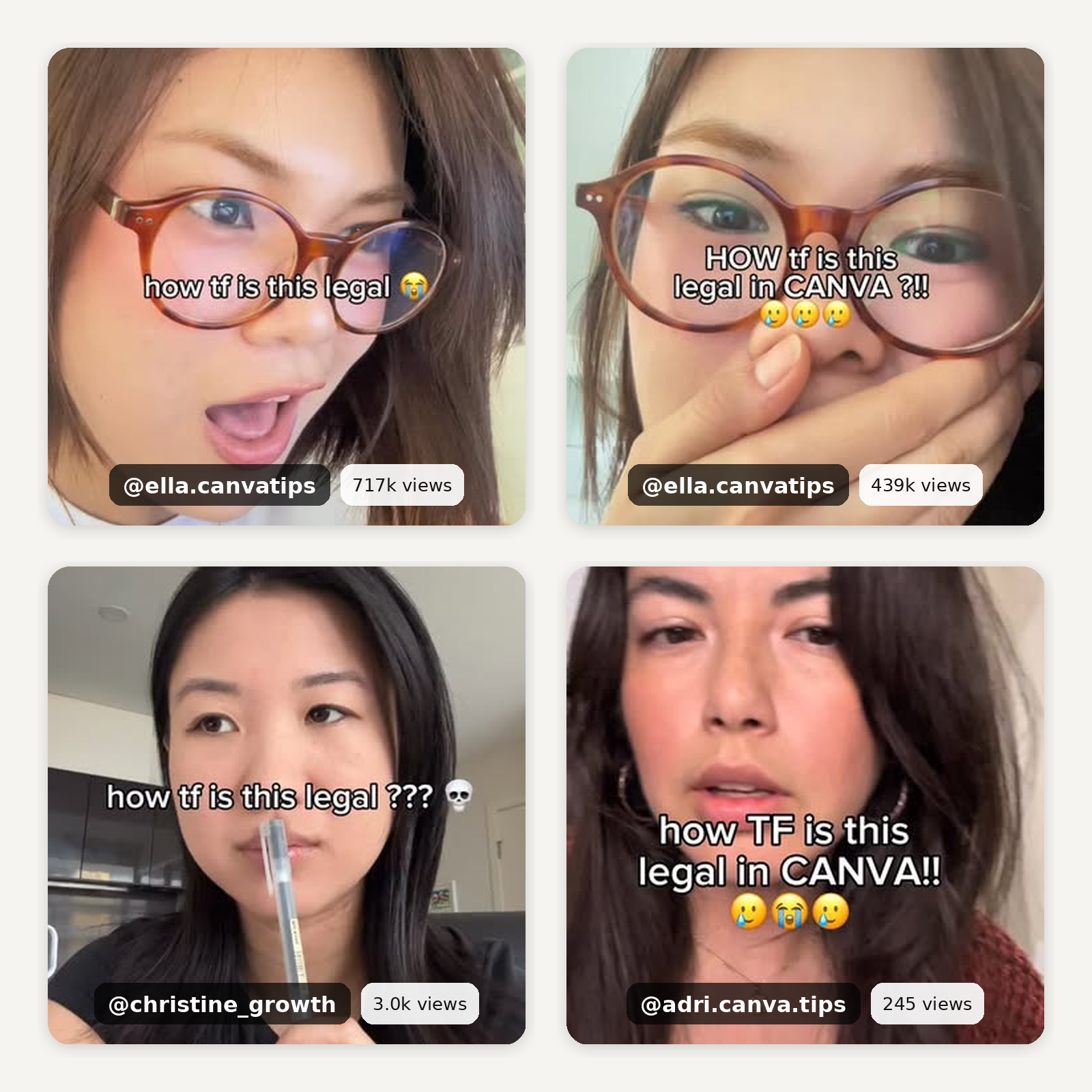
The strongest mirrored Instagram account in the cluster was @ella.canvatips.
A few of the creator-style Instagram accounts repeating the Carousel Studio hook family.
Two native examples are worth looking at directly because they show the mechanic very clearly:
This is useful because it shows two things at once:
some accounts still look like true seed accounts
at least one creator in the cluster has already broken out well beyond the seed stage
That mix is common in examples of viral marketing: there is usually a long tail of small tests, and then a smaller set of posts that actually catch.
Why the hooks work
The hook family is doing the same job again and again.
1. It creates curiosity fast
“how is this legal?” is not elegant copy.
But it is native to the feed and instantly tells the viewer this might be a shortcut, loophole, or unfair advantage.
2. It identifies the audience immediately
These posts are not talking to everyone.
They are clearly aimed at:
social media managers
founders making content
freelancers
creators trying to ship more content faster
That makes the hook stronger because the audience feels recognized in the first second.
3. It puts the payoff before attention drops
The best-performing videos do not spend long explaining.
They show:
open Canva
open the app
paste the prompt
generate the carousel
reveal the output
That is one reason the format maps so well to the same principles behind how to make a reel go viral: fast setup, visible payoff, no wasted intro.
What the comments reveal
The comments are the most useful part of this case.
On the strongest @ella.canvatips posts, the comments split into three buckets.
Replication intent
People wanted the exact workflow:
“prompt?”
“Can u share your prompt pls😭”
That is strong signal.
The content is not just getting attention. It is making people want to copy the process.
Shortcut / insider reactions
Some viewers reacted like they had discovered something unfairly useful:
“please delete this. My future boss should not know about this😂”
That kind of reaction is valuable because it means the product is being understood as leverage, not just software.
Quality objections
The same posts also drew skepticism:
“too basic”
“AI slop”
complaints that the output still needed editing
This is not bad news.
It is often what strong product-led UGC looks like.
People want the shortcut, and then immediately test whether the output is good enough.
That tension is far more useful than passive likes.
It tells you exactly where the product is creating demand and exactly where objections show up.
Why this matters beyond Canva
The real lesson is not “Canva is good at UGC.”
The more useful lesson is this:
Performance UGC works especially well when it sells a workflow shortcut, not just a brand.
Carousel Studio has a few qualities that make this work:
the output is visual
the pain point is obvious
the time-saving promise is easy to understand
the product can be demonstrated in seconds
viewers can imagine themselves using it immediately
That is what makes it feel more like a performance UGC product than a normal software tool.
What teams can copy
If you want to adapt this pattern, the reusable parts are simple.
Focus on one product, not the whole platform
Do not try to sell your whole category in one video.
Find one narrow workflow shortcut.
Use one audience and one pain point
The Canva cluster works because the targeting is not fuzzy.
It repeatedly speaks to the same type of person with the same frustration.
Build around one hook family
You do not need 30 creative directions.
You need one hook family that can be repeated across creators with small variations.
Let comments do part of the selling
The comments surface:
prompt demand
objections
social proof
desire to try the workflow
That is part of the conversion path, not just engagement noise.
The copyable playbook is simpler than it looks.
One product. One audience. One obvious pain point. One repeatable hook family. Then distribute it
through a small creator-style cluster instead of treating every post like a brand film.
Questions & Answers
The visible content often feels like it is promoting Canva, but the underlying product being pushed is Carousel Studio, a Canva app by Engyne. The safest interpretation is that this is a creator-style distribution pattern around Carousel Studio inside Canva’s ecosystem, not necessarily a Canva core campaign.
Because the posts behave like conversion-oriented creator ads: they identify a specific audience fast, frame a painful workflow problem, show the product in action, reveal the payoff quickly, and trigger comments that expose both demand and objections.
The comments show whether the content is creating real commercial signal. In this cluster, comments like 'prompt?' show replication intent, while reactions like 'too basic' or 'AI slop' reveal where the product still triggers objections. That is much more useful than passive engagement alone.
Final read
This is the core lesson: if a product has a clear workflow shortcut, a visible payoff, and creator-native packaging, it can behave like a performance UGC product even inside a larger software ecosystem.