A repeatable method to find short-form formats that already work, check whether they convert or just entertain, and turn them into briefs any creator can execute.
Reading time17 min read
Written by
UpdatedSeptember 2026
In a high-volume program, the question isn't "what should we make?" once. It's every week, for every creator. This chapter gives you a research method that answers it with evidence: where to find formats, how to tell a converting format from cheap entertainment, and how to package it into a brief. Chapter 1 covered how to pay for this volume.
Trend research principles
Before you open TikTok or Instagram, set one rule: stop hunting for 100% original, never-seen-before ideas. In short-form video, fast adaptation beats raw originality. Your goal is to find content frameworks that already work and remix them for your product.
What counts as a trend
A single viral video isn't a trend; it's a fluke. A trend is a repeating blueprint that works across multiple videos and different accounts. When you browse, look for patterns in:
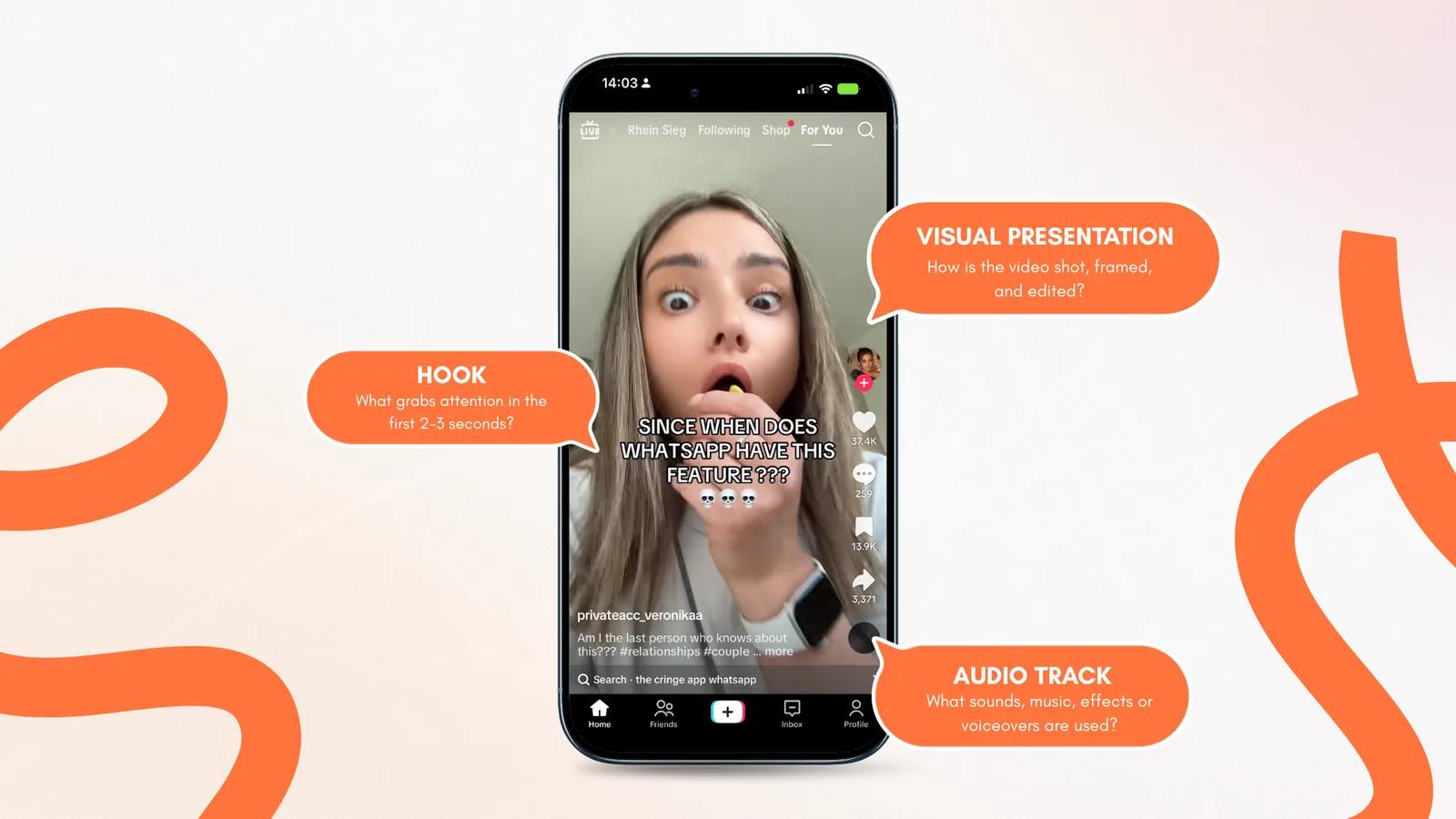
Hook families: are creators using the same text-overlay format or opening line?
Visual setups: are they filming in their cars, using a green screen, or doing a desk POV?
Pacing and cuts: fast jump cuts, or slow aesthetic B-roll?
CTA patterns: how do they get people to comment, share, or follow?
Emotional triggers: FOMO, lifestyle envy, or everyday frustration?
Product demos: how is the tool or product introduced?
Cluster videos before you call it a trend
Never call something a trend until you've found a family of videos doing it. When you spot a format you like, find 5 to 20 examples, then group them by these fields to see what repeats:
Hook: the exact text or spoken line in the first 3 seconds.
Visual setup: framing, background, or screen-recording style.
Product role: how the product fits into the story or the solution.
Creator archetype: the persona, such as the blunt expert, the clueless beginner, or the cozy aesthetic creator.
Audience emotion: the feeling driving the viewer, such as anxiety, aspiration, or relief.
CTA and comment behavior: what the video asks for and how people actually react in the comments.
Save or share reason: the trigger that makes someone send it to a friend or save it for later.
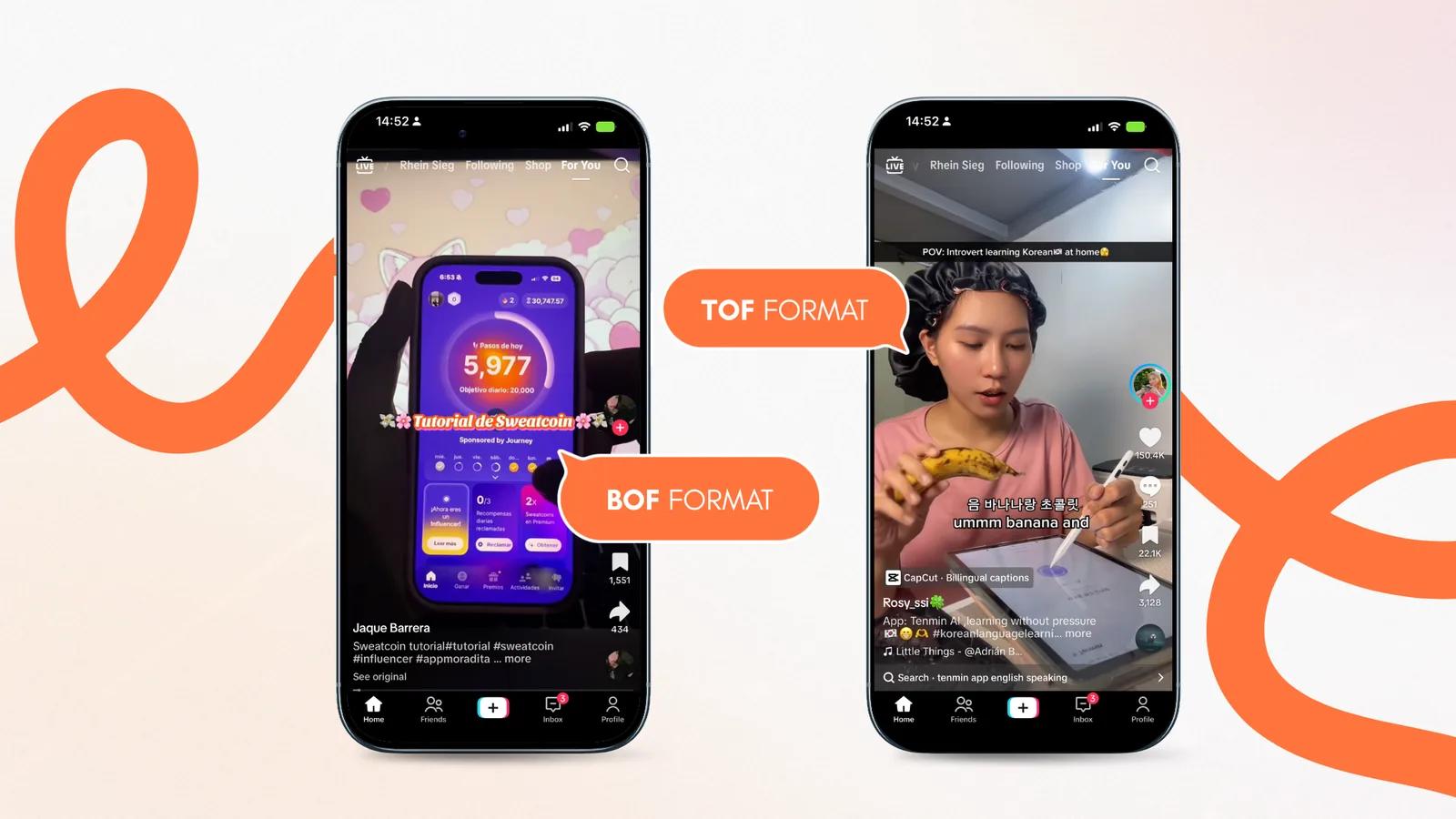
Funnel role: whether the format is built for top-of-funnel (TOF) reach or bottom-of-funnel (BOF) conversions.
Change how your team talks about wins
Never say 'this video did well.' Say 'we found 8 videos across 4 different accounts using this exact visual mechanic.' That one change moves a team from chasing one-hit wonders to executing repeatable frameworks.
Where to source formats
TikTok
Train the algorithm. Spend 5 to 10 minutes liking, saving, and fully watching niche videos, and follow 5 to 10 key accounts. The feed then does the work of surfacing fresh trends for you.
Search by keyword. Search for specific problems, audience desires, and your product category, such as "anxiety journaling" or "budgeting tips."
Track hashtags. Look up niche outcomes by hashtag (for example #mentalhealth, #ugccreator, #tiktokads) and keep a list of the ones that keep surfacing high performers. Watch the medium-sized, specific hashtags where core fans gather, not just the huge ones.
Research sounds. Tap trending audio or meme sounds to see how different creators adapt the same audio to their style.
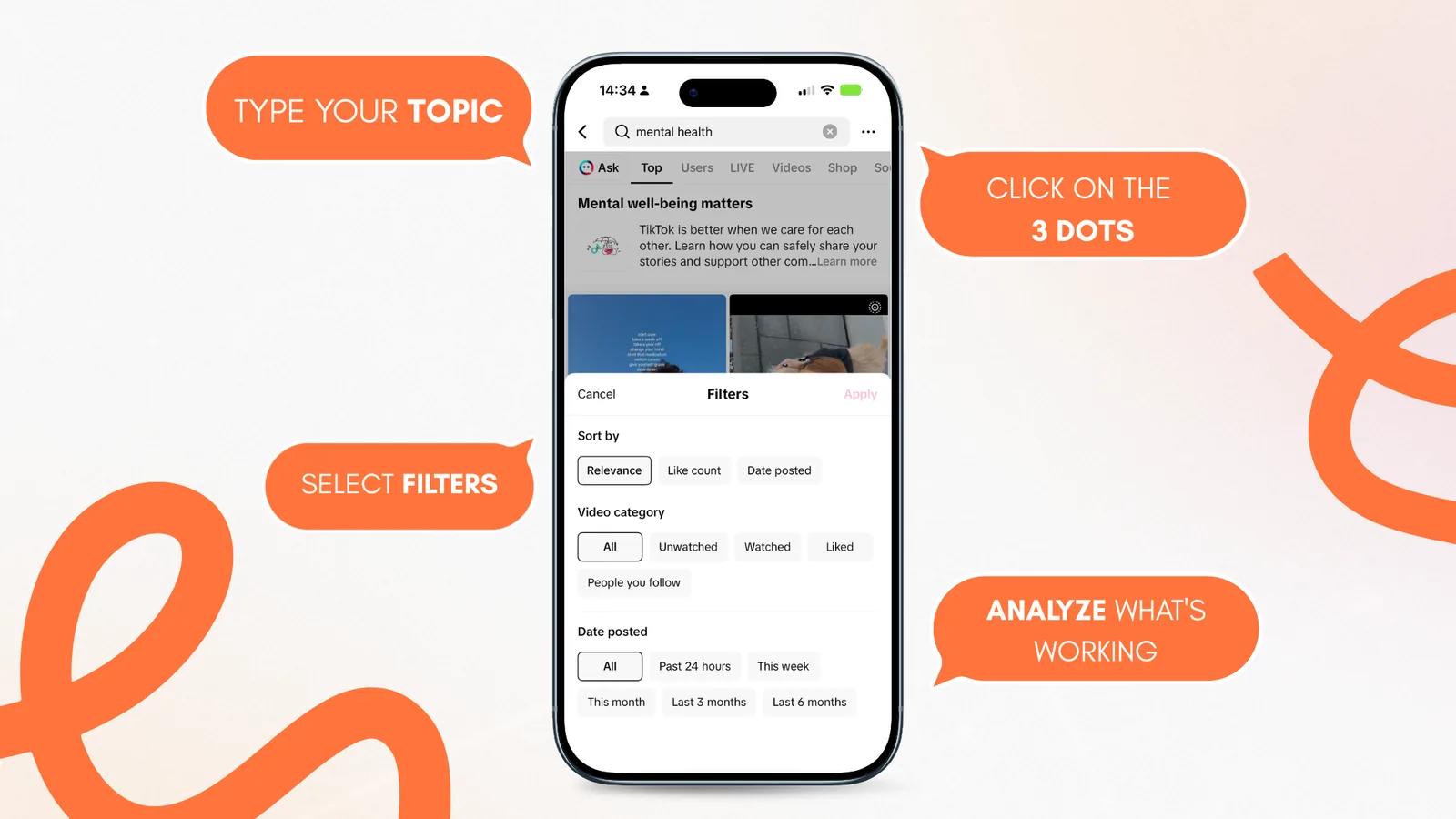
Filter and sort. Sort by most liked or relevance to find classic formats, then switch to this week or this month to catch rising trends before they saturate.
Find small accounts with big views. An account with 3k followers and a 500k-view video tells you the format and hook did the heavy lifting, not the creator's fame. Favor setups that work on fresh, faceless, or low-polish brand accounts.
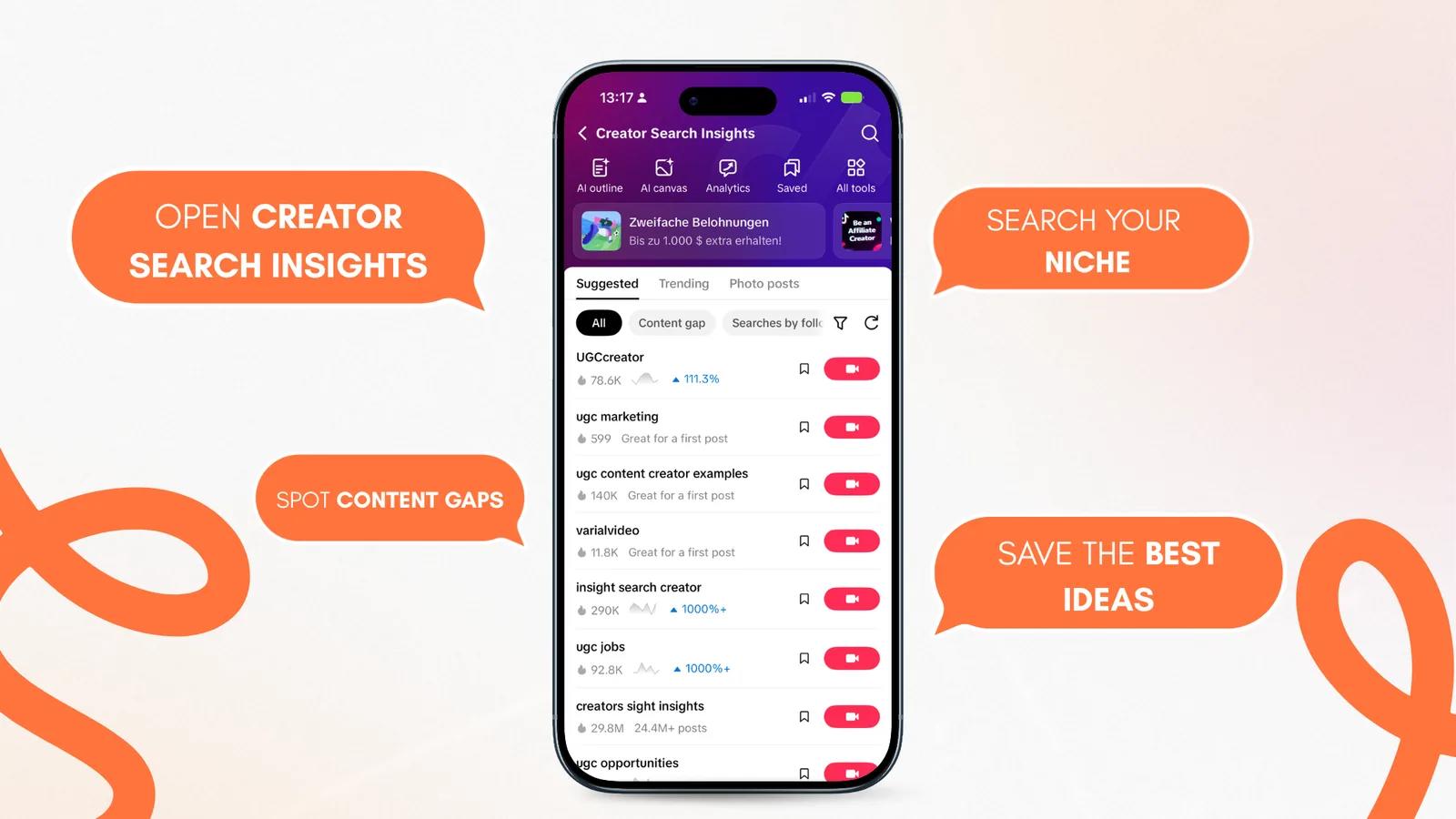
Use Creator Search Insights. This TikTok tool shows what people type into search. Look for content gaps, topics with high search volume and few good videos, and save them to your content queue. More on this in how search is changing high-volume UGC on TikTok.
Instagram Reels
Analyze the Explore tab. Search your niche keywords to see what Instagram is actively pushing.
Filter your feed on purpose. Adjust your interests toward your niche and engage with, save, and fully watch the exact Reels you want to study, so the algorithm surfaces niche content instead of broad consumer trends.
Find outlier Reels. Check 10 to 15 competitor and creator accounts and compare each Reel's views with the account's follower count.
Outlier Reels show which hooks, topics, and formats actually resonate, not just what an account posts often. Focus on smaller accounts: their outliers are much easier to replicate than a mega-influencer's.
YouTube Shorts
Build a format library. Shorts are good for finding simple, punchy structures such as quick before-and-afters or three-point advice lists. Track videos that perform far above the channel's average.
Favor simple formats. Look for Shorts that win with a strong hook, a relatable problem, and a satisfying payoff, not with expensive editing.
Pinterest Trends
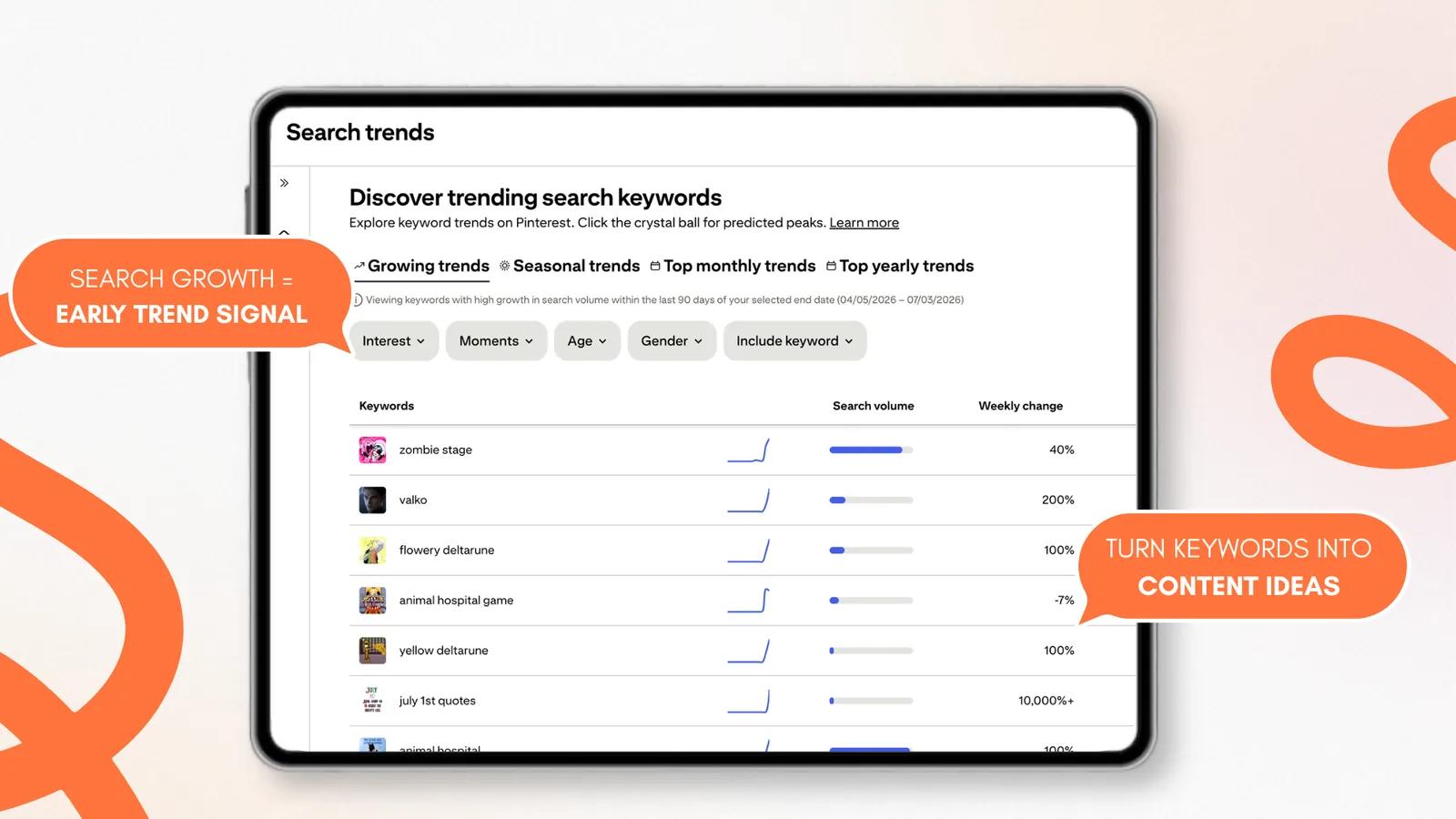
Catch trends early. People often search on Pinterest before a trend reaches mainstream short-form video. Use the Pinterest Trends tool to monitor rising keywords and monthly shifts.
Look at saves, not just views. High save rates show which aesthetics, features, and visual styles people plan to spend money on next.
Map keywords to campaigns. Pinterest lets you target the keywords people actively search, which turns a raw trend signal into a concrete content idea or ad opportunity.
Layer match types: broad match for discovery and adjacent trends, phrase match for tighter relevance, exact match for narrow intent, and negative keywords to filter out irrelevant searches.
Collect the language. Pinterest recommends a large keyword set per ad group, which makes it useful for mapping the exact words real people use to describe a topic or problem.
Your competitors
Don't guess what to make. Look at what already works for companies that share your audience, and borrow ideas from neighboring industries.
Find direct competitors. Search your niche, product type, or the main problem you solve on Instagram and TikTok, and note brands selling similar products to the same customer. On Google or Google Maps, search your industry keywords plus "best" or "top."
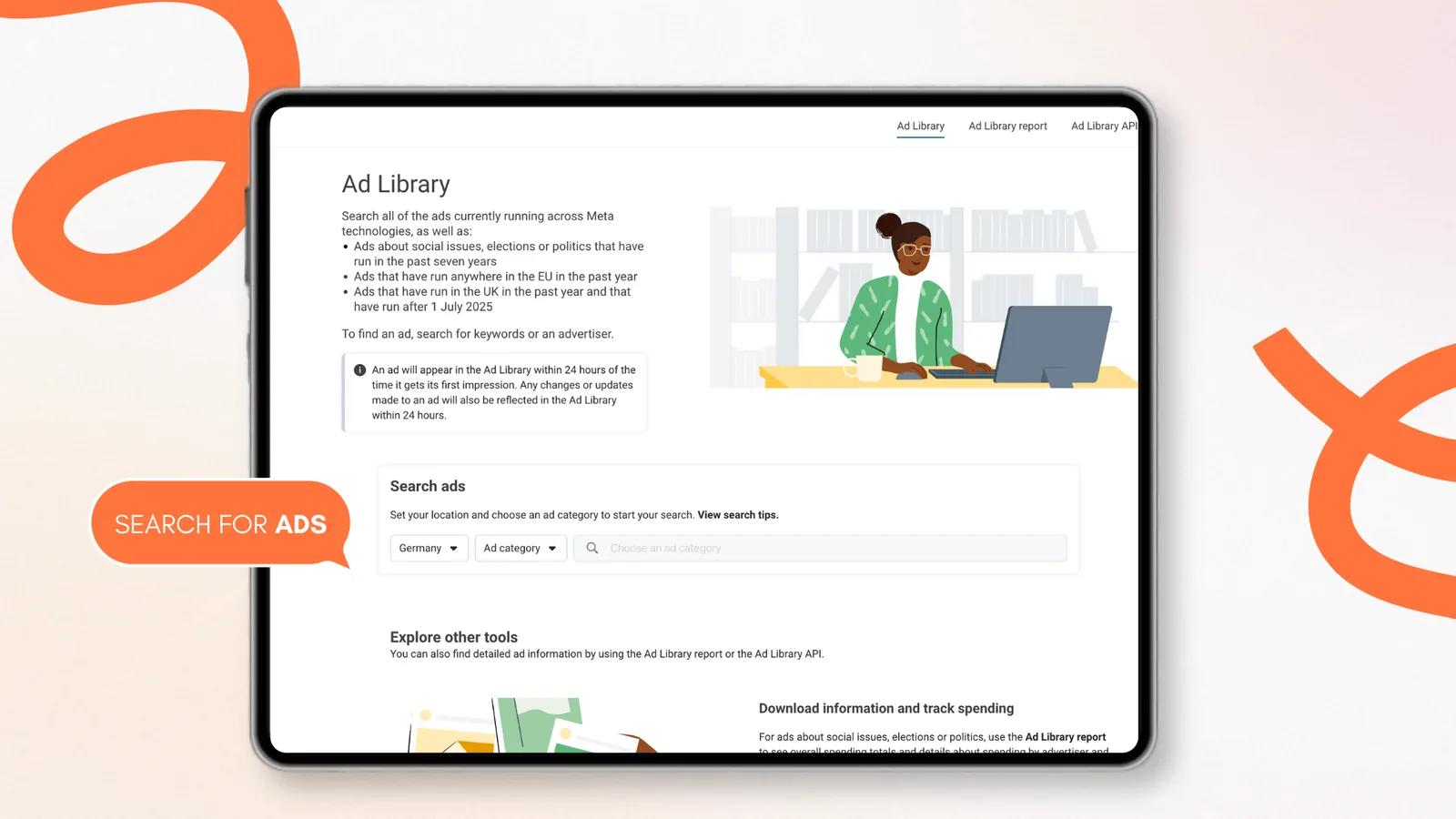
Check their paid ads. Enter competitors' names in the Meta Ad Library to see the ads they are actively paying for. When a brand keeps spending on a video style, that format is making them money. TikTok has its own ads library and Creative Center for the same research.
Find their creator partners. Check captions, tagged accounts, and recurring faces in competitors' videos, and list the creators they use again and again. A creator who keeps getting rehired is part of a winning system. You can also look at who competitors follow or search for partnership tags like #BrandNamePartner.
Borrow formats from other niches. Great video styles often start in a different industry. Catch them early and bring them into your niche before your direct competitors do:
Look past your rivals at the top performers in neighboring industries, and study only the big winners.
Watch for patterns such as fast wisdom ("10 years of experience in 60 seconds"), versus videos (cheap vs. expensive, beginner vs. expert, before vs. after), and reworked concepts (a layout from another space with your product dropped in).
To adapt one: note its hook, setup, and cut speed. Ask whether your audience would care about the same feeling or promise. If yes, rebuild it with your own product, text, and visual style.
Make one or two test videos before you change your whole content plan.
The viral.app viral video library
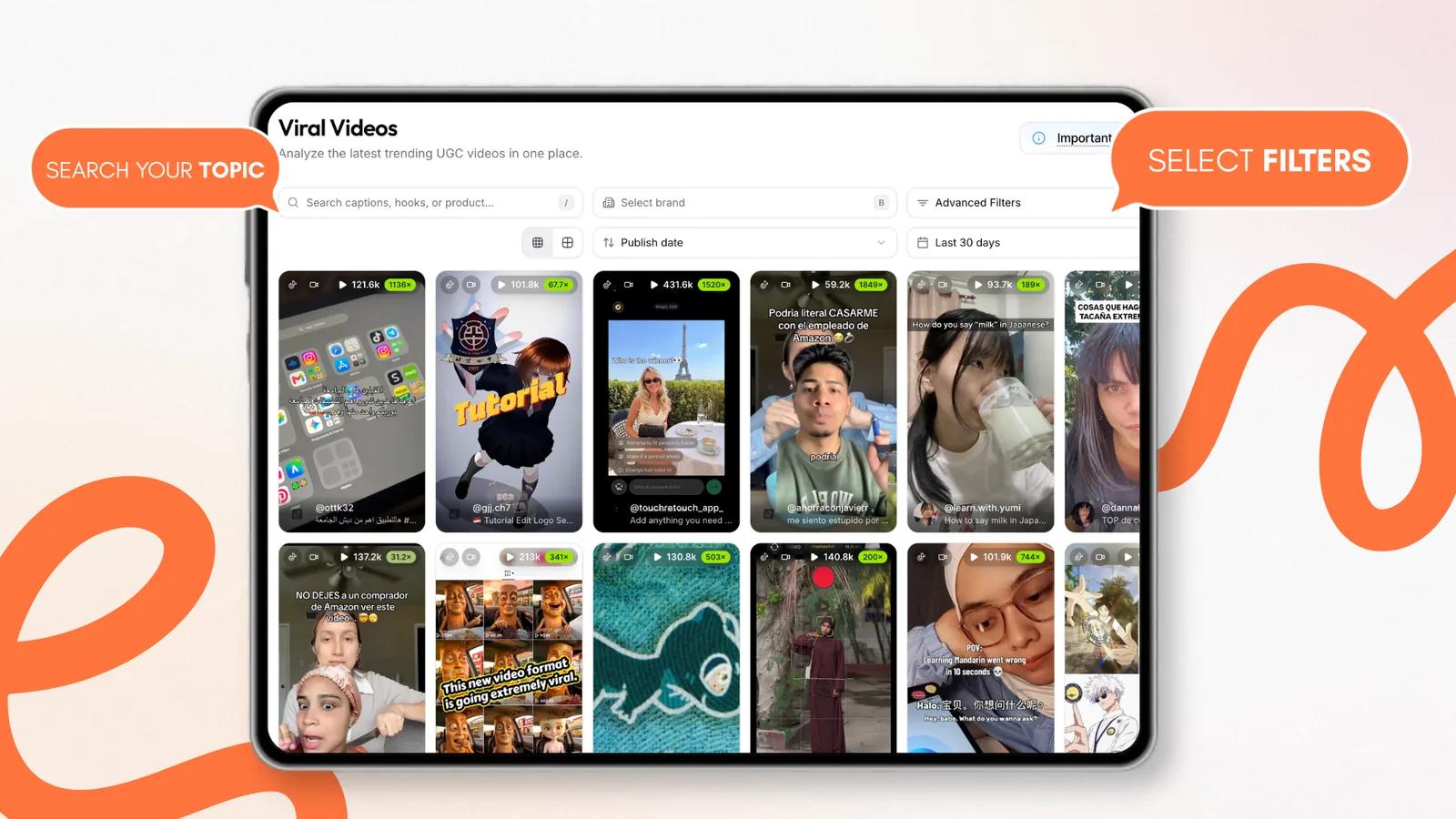
Scrolling five platforms by hand takes hours. The viral video library in viral.app collects viral UGC with AI classifications and commercial signals, so you can filter instead of scroll:
Performance and scale: set a minimum view count to cut noise and a minimum outlier factor to skip big influencers and surface small accounts that went viral because of the format.
Product and brand detection: see how physical products, software interfaces, and services are shown on camera.
Product type and vertical: narrow to your business model (SaaS, mobile app, e-commerce physical or digital, service) and market (for example AI tools, marketing and sales, finance, beauty and fashion).
Format and hook style: filter by format (screen recording, skit or POV, tutorial, product demo, listicle) and hook style (curiosity gap, contrarian take, bold claim, mistake warning, pain-point callout).
Matched terms: find videos around specific audience phrases such as "best AI apps," "budgeting tips," "productivity hacks for students," "skincare routine," or "side hustle."
Reddit is where audiences speak unfiltered, which makes it a rich source of hooks, angles, and ideas that feel real.
Pick subreddits in your category, such as r/SkincareAddiction, r/personalfinance, or r/SaaS.
Sort by top posts of the last month or year. Which problems are people obsessing over? Which common industry advice makes them angry?
Collect the phrasing. Lines like "I was today years old when I realized..." or "Is it just me, or is everyone secretly struggling with..." make strong hooks because they sound like real thoughts, not advertising.
Google Trends
Before you build a content plan around a topic, make sure it isn't dying out.
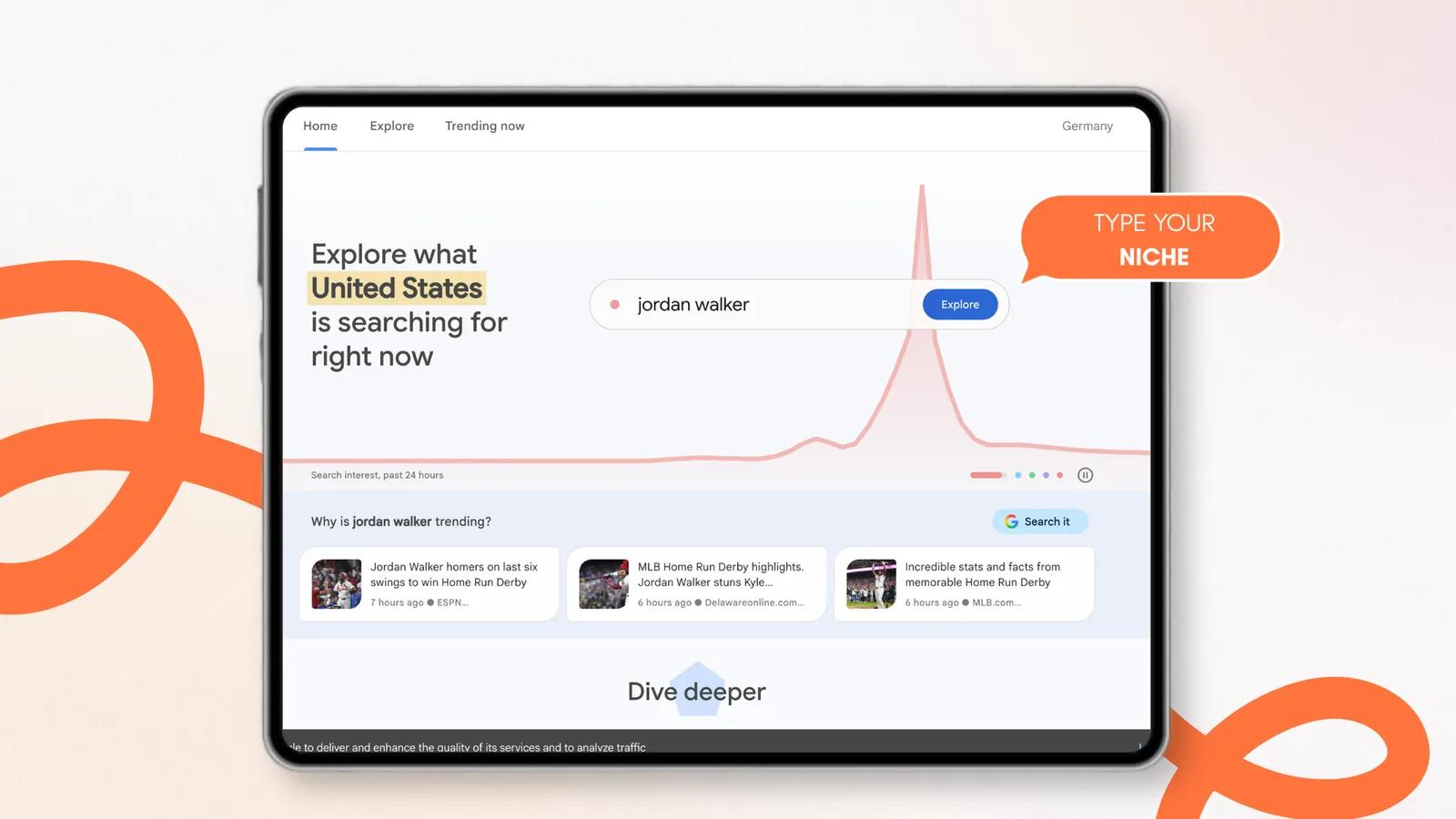
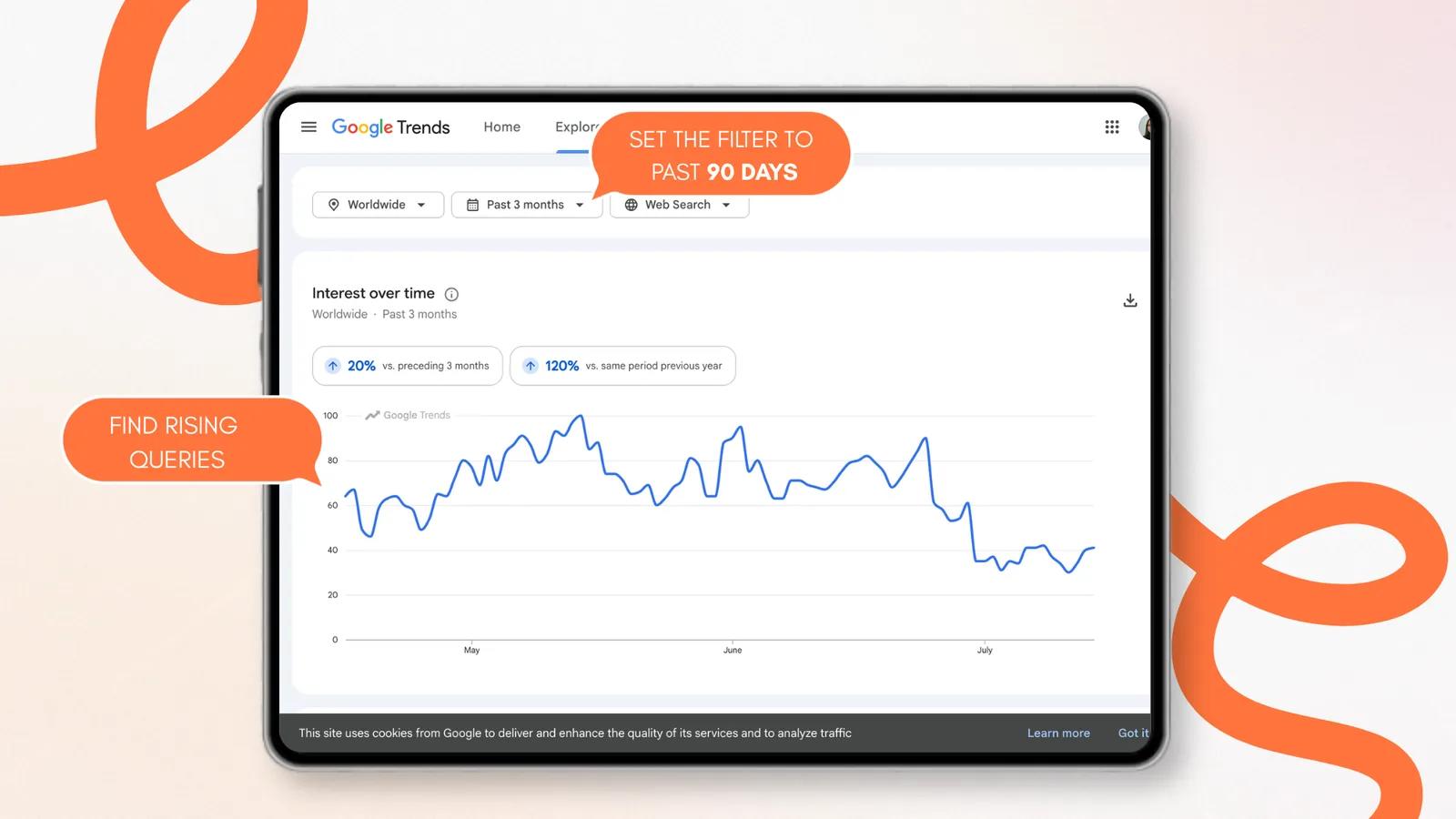
Validate search interest. Enter your core topic keywords and look at the 90-day and 5-year trends. Is interest rising, stable, or falling?
Map related queries. Check the related queries and rising sections at the bottom of the page. They show breakout terms and subtopics that give you a fresh angle before others find it.
The comment-section method
Don't read comments just to confirm a video is popular. Treat the comment section as its own research method: often a video creates the desire, and the comments do the converting by answering buyer questions and pushing people to act. For each winning structure, read the top 50 to 100 comments and tally them into these categories:
High-intent buying signals
App or source requests: "What app is this?", "What tool are you using?", "Where is the link?"
Prompt or template requests: people asking for the exact framework, ChatGPT prompt, or CapCut template shown.
"Is this free?" questions: people checking the cost before they click.
Friction, objections, and roadblocks
Price objections ("Too expensive," "Not worth $20 a month") that your own videos need to answer in advance.
Privacy and safety concerns: "Is this safe?", "Does this steal my data?", "Is this a scam?"
"Does this actually work?" skepticism about edited results.
Troubleshooting questions from people who got stuck ("It says error for me"), which show where competitors' onboarding fails.
Viral loops and organic reach
Friends tagging friends, the clearest sign of shareability.
"This is me" relatability: "I feel attacked," "Literally me at 3 AM," "Finally someone said it."
Fatigue and ad blindness
"I'm so tired of seeing this video" or "Another day, another ad for this app." Too many of these mean the format is saturating and needs a fresh variation.
CTA success
Comments that do exactly what the creator asked. If the creator said "Comment 'GROW' and I'll send you the link," the comments should be full of "GROW." If they aren't, the hook or the reward was too weak.
Filter and analyze what you found
With trends sourced, look under the hood, filter out the noise, and find what actually drives conversions.
Video anatomy
Pick your best examples, watch each 2 to 3 times, and break them down:
The hook (seconds 1–3): what text is on screen, what is the opening line, and which hook family is it?
Visual presentation: POV, screen recording, aesthetic B-roll, or a dramatic product close-up? Does the text stay on screen or disappear?
Structure and pacing: snappy jump cuts or one continuous clip? Is the answer given right away, or held until the last second?
Audio: a casual talking-head voiceover, or a trending sound carrying the joke?
Account type: does the trend live on a big personal account, a faceless page, or an official brand account? Are several creators repeating it across languages and markets?
Virality vs. conversion signals
Separate cheap entertainment from commercial virality before you replicate a format. Ask three questions:
Does it trigger high-intent actions? A video with 1 million views and 500 saves is entertainment. A video with 100k views and 25,000 saves has utility people want to come back to. High save and share ratios are the strongest validation for software, apps, and digital products.
Does the product fit naturally? Can your product slot into the story, or would forcing it in break the viewer's immersion? If a format relies on an emotional personal story and you suddenly pitch a B2B SaaS tool, viewers swipe away. The product has to be the natural answer to the problem the format sets up.
What do the comments say? Ignore the comment count and read the top comments. Jokes, emojis, and memes mean entertainment. Buying questions ("What's this tool called?", "Can I get the link?", "Is this on iOS?") mean a format built for conversion.
Funnel role: top or bottom of the funnel
Never evaluate a video without knowing its job. Tag every validated trend as TOF or BOF so you don't hold an awareness video accountable for direct revenue:
Top-of-funnel formats are broad, relatable, light, and built for organic sharing. They tap into universal experiences, everyday frustrations, or identity humor. The product makes a casual cameo or sits in the background. The goal is to teach the algorithm who your audience is, lower your blended customer acquisition cost (CAC), and win cheap impressions at scale.
Bottom-of-funnel formats have one job: get people to buy or download now. They use explicit problem-solution frameworks, feature close-ups, step-by-step workflows, live screen recordings, and direct comparisons. The product is front and center, and the video exists to show a pain point and prove your tool solves it. The goal is click-through rate (CTR), cost per install (CPI), and direct revenue.
Product-category fit
A format that works for a makeup brand can fail for an AI tool. Before you approve a format, your product should meet at least two of these:
Instant visual clarity. Can a viewer understand what the product does and why it matters within 5 seconds of seeing it, without reading a caption? A product that needs a 3-minute abstract explanation fails short-form.
A core emotional driver. Does the trend map to one of the main reasons people act: avoiding a problem or mistake (anxiety), making money or landing a job (financial gain), saving hours of manual work (time), or lifestyle, beauty, or organization (status and aesthetics)?
An "aha" moment. Does the format let your product deliver a high-contrast before-and-after, a reveal, or a quick win the viewer feels instantly?
Product entry point
The second your product appears shapes the whole retention curve. Record the timestamp of the product's first appearance in your reference videos:
Frame 1 (the direct hook): the product is visible immediately. Works for visually striking products or interfaces that are the hook themselves.
After the hook (second 3–4): the creator states the problem in the first 3 seconds and brings the product in at second 4 as the answer. Retention stays high because curiosity is satisfied before viewers drift.
Mid-story (second 15–20): the creator builds a personal story or tutorial first, and the product appears later as something they discovered along the way. Maximizes watch time but loses people who swipe early.
Climax reveal (the last frame): the product stays hidden until the end as the reveal or punchline. Maximizes completion rate but limits brand exposure if the hook isn't strong.
Engagement vector
Every viral format has one dominant engagement driver that shapes how the platform distributes it. Classify it, so you know how to write the call to action:
Lifecycle and saturation
Short-form formats age fast. Copy a trend at the wrong moment and you pay more for less while viewers are already tired of it. Place every format on the lifecycle curve before you approve it:
Early signal. Only a few creative accounts use the format, views are very high relative to follower counts, and the comments show real excitement and curiosity. Action: copy it now. You have a window of cheap traffic.
Validated. Agencies have found it, brands in adjacent niches run paid variations, and it converts consistently. Action: build your variations now. The audience is educated and buying.
Saturated. The format has been copied thousands of times, it's in mainstream feeds, and the top comments are cynical ("Another day, another ad using the same setup"). Action: don't copy it directly. If you use it at all, pivot to a specific sub-feature or a parody that breaks the audience's expectation.
Turn formats into briefs
A vague instruction like "make a cool video about our budgeting app" produces low-converting, high-friction videos. This step turns your research into briefs any creator can execute.
Hook families
Don't let creators invent random openings or copy text word for word. Have them pick from these eight hook families, each with a structure they can adapt:
Hidden truth. Taps the urge to uncover secrets. "What [industry experts] don't want you to know about [topic]..."
The secondhand secret. Sidesteps skepticism by framing the video as a personal recommendation. "My friend made me download this app last night, and it fixed my..."
The impossible claim. Makes a big efficiency promise that dares viewers to doubt it. "How I automated 10 hours of manual admin work in 30 seconds."
The regret reveal. Plays on fear of wasted time and missed chances. "My biggest regret is waiting until my 20s to find this free tool..."
The direct comparison. Creates instant clarity by contrasting the old, painful way with the new, easy one. "Tracking expenses manually vs. using this one-click app."
The accidental discovery. Feels like a lucky find rather than a pitch. "I was messing around on GitHub at 2 AM when I found this shortcut..."
Forbidden knowledge. Offers an unfair advantage over everyone else. "Productivity gatekeepers are going to hate me for sharing this..."
The direct callout. Filters for buyers by naming a specific identity or pain point. "If you're a freelance designer making less than $5k a month, stop scrolling."
Constants vs. variables
To scale a format without losing what made it work, split it into what stays fixed and what creators can change:
Format screening scorecard
Score every trend candidate from 1 (poor) to 5 (excellent) on these ten fields before it enters your production calendar. Anything under 35 out of 50 gets scrapped.
Outlier strength: does the reference video show 5× to 10× the creator's usual views?
Repeatability: can creators with average editing skills pull it off without special equipment?
Product fit: is your product the natural answer to the problem in the video?
Product clarity: can an average viewer understand what your product does within 5 seconds of seeing it?
Comment intent: are the reference comments full of buying questions rather than bots and memes?
Save and share power: is it built to be saved as information or shared as an identity statement?
Small-account viability: could it reach big numbers on a brand-new, faceless account?
Low fatigue risk: is it early in its lifecycle, or does it have a unique angle that avoids ad blindness?
Briefing speed: can you explain it to a creator in a 60-second video or one page of text?
Localization potential: does the payoff work across markets and languages without structural changes?
Format-to-brief checklist
At volume you can't tell a team to "make something cool." Give them a recipe that lets anyone replicate a trend without losing what made it work:
Trend name: a short, catchy title everyone recognizes.
3–5 inspiration links: the original viral videos, so creators see the speed, pacing, and energy.
Hook formula and opening frame: 3 to 5 on-screen text options for the first 3 seconds. Changing the text hook is the easiest variable to test.
Script template: what happens at which second. For example: seconds 1–3, the creator's face with a text overlay; second 4, cut to a screen recording of the product; second 25, the call to action.
The CTA: a specific instruction such as "Tap the link in the pinned comment to try it free," not "check us out."
The pinned comment: the text to copy, paste, and pin, with a short reminder and the link.
What to copy and what to avoid: which elements to keep from the original (for example the casual split-screen layout) and which to drop (a slow intro).
Variations: at least 5 alternative hooks and 3 niche angles so the team can test at scale.
Chapter 4 shows how these formats feed a brief library your whole creator roster works from.
Train your feed by watching and saving niche videos, search by keyword and hashtag, check trending sounds, sort by most liked and then by this week, look for small accounts with big views, and use Creator Search Insights for content gaps.
Look for 5 to 20 videos from different accounts that share the same hook, visual setup, or structure. A single viral video is a fluke, not a format you can brief.
Check saves and shares relative to views, whether your product fits the story naturally, and whether the top comments ask buying questions such as "What app is this?" rather than posting jokes and emojis.
Top-of-funnel formats are broad, relatable, and built for sharing, with the product in the background. Bottom-of-funnel formats put the product front and center to drive clicks, installs, and sales.
When the format has been copied thousands of times, sits in mainstream feeds, and the top comments turn cynical about seeing it again. At that point, pivot to a sub-feature or a parody instead of copying it.
Appendix: automating research and staying safe
Automate the research
To analyze hundreds of viral videos a week, many teams run a simple pipeline:
Collect links. Paste every winning video you spot into a shared spreadsheet or database.
Download and transcribe. A script grabs the video and creates a timestamped transcript.
Break it down with AI. The video and transcript go to an AI model such as Gemini, which tags the hook type, creator style, product entry second, and cut pattern.
Group the patterns. A dashboard groups similar styles, so you see the frameworks working across the internet instead of random noise.
Four things to keep out of public trend reports
If you manage several brands or publish trend reports to show expertise, your research is a competitive advantage. Before you publish, remove:
Your clients' active winning formats. Competitors can copy a format within 48 hours of seeing it.
Your best creators. Name the micro-creators who perform for your clients and rival brands will hire them and bid up their rates.
Competitor deep dives. Use detailed research on your clients' rivals internally, where it helps them win.
Your secret sauce. A new psychological angle, editing style, or comment strategy that drives sales is worth more used than posted.
Next: chapter 3 covers where to find the creators who will make these formats.