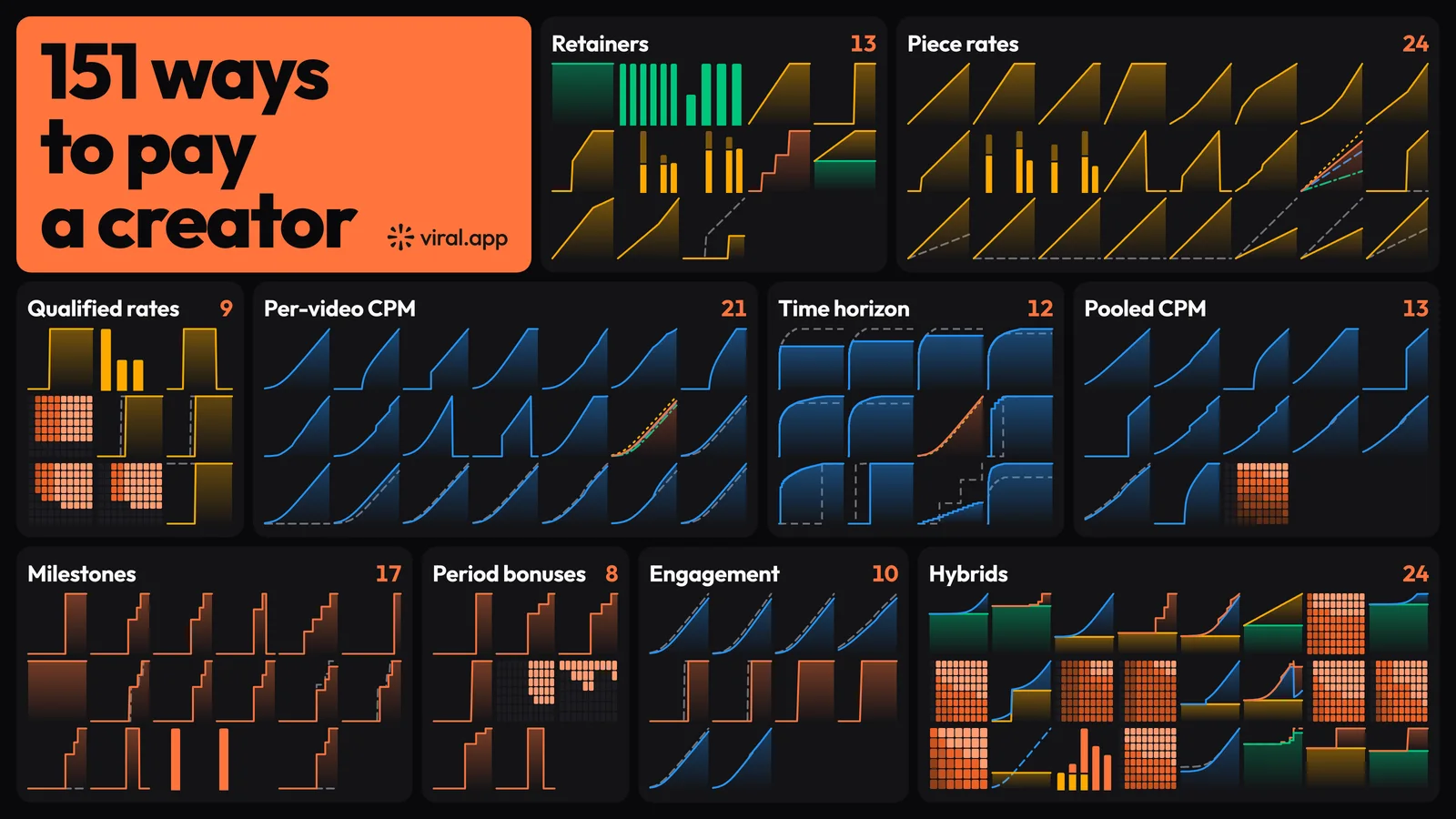
Pay models charted
151
Each one with example terms, trade-offs and its own link.Families
10
From flat retainers to deals that use every part at once.Parts in a deal
4
Salary, base, CPM and bonus, plus two caps on top.A creator compensation model is the rule that turns a creator's work into a payout. Most short-form deals are built from four parts: a fixed salary, a base fee per video, a CPM on views and flat bonuses at view milestones. Caps, counting windows and qualifying rules decide how those parts behave. We ran 151 models through viral.app's payout engine and charted what each one pays, so you can see a deal's shape before a creator signs it.
Below you can build a deal with your own numbers, answer three questions to get a starting model, or search all 151. The ten sections after that explain each family and when it fits.
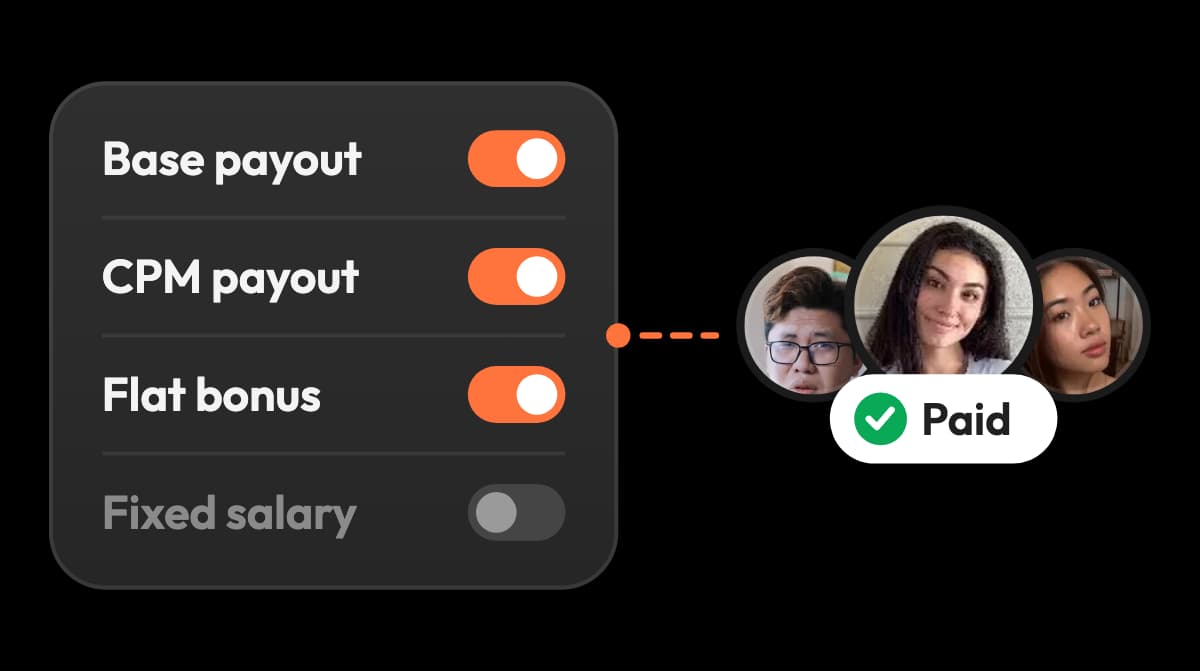
A creator compensation model sets what a creator earns for their work on a campaign. On short-form video, that work gets paid in four ways.
Written as a sum, one cycle of pay looks like this. A cycle is one payout period, usually a month.
Pay = salary + base (up to its cap) + CPM and bonuses (up to their cap)
Each part prices on its own and the results add up. Every model on this page is a version of that sum, so learning the four shapes gets you most of the way.
Flat Retainer: A fixed amount every cycle, whatever gets posted.
Example terms: $400 a month
Set the four parts and the two caps, then drag along the chart to read the pay at any view count.
| At 100 views | $202 |
|---|---|
| At 536 views | $211 |
| At 2.87K views | $257 |
| At 15.3K views | $508 |
| At 64.9K views | $1.2K |
| At 348K views | $1.2K |
| At 1.86M views | $1.2K |
| At 10M views | $1.2K |
The lab counts every view inside one cycle.
Start from Base + capped CPM at 20 videos. If every video gets 1,000 views, the cycle costs $220, or $11 per 1,000 views. If every video gets 1 million views, it costs $1,200, or $0.06 per 1,000 views. On the same deal, a view costs more than 180 times as much in the first case. The base pays for the work on flops, and the cap stops a viral month from running away.
Both axes start on log scales, because most videos land at the low end, where a linear chart shows almost nothing. Switch the dollar scale to linear to see raw dollars. Views stay on a log scale, since a linear one would squeeze everything under 100,000 views into a sliver at the left edge.
Three questions narrow the list: what you're buying, who carries the risk of a flop, and how much a good month may cost.
Per-video pay with a limit on performance spend.
Example terms: $10 per video + $1 CPM, capped at $1,000 a cycle
If nothing pulls you toward another model, start with Base + Capped CPM. It pays for the work, shares the upside and puts a ceiling on a viral month, and it's simple enough to explain in one line of a brief.
Who controls distribution should drive your second answer. When creators post on accounts you own, or you set the hook and the offer, results depend on you as much as on them, so guarantee more of the pay. Performance-only pay fits creators who post to their own audience and choose variable income for the upside.
Search by name or term, filter by family or by the parts a model uses, and open any model to read its chart, terms and trade-offs. Compare lays a second model's total over the chart. Every model has its own link, which helps when you're agreeing terms with a creator or a finance team.
Per-video pay with a limit on performance spend.
Example terms: $10 per video + $1 CPM, capped at $1,000 a cycle
All rates are examples, there to show a shape. For what creators earn today, see our live UGC rates. Models marked Advanced run on the same payout engine, but the campaign builder can't set them up today.
A retainer pays a set amount each cycle. Flat Retainer is the simplest deal on this page and the most forgiving: a creator who posts nothing still gets paid. Most of the other 12 keep the headline number and tie it to delivery. Quota-Scaled Retainer splits the sum across a video target, so each missing video lowers the pay. All-or-Nothing Retainer pays only a full target. Catch-Up Retainer holds a missed cycle's money until the creator is back on target.
Tying pay to delivery has a second benefit. In some countries, a fixed monthly sum that doesn't depend on output can look like employment.
Flat Retainer: A fixed amount every cycle, whatever gets posted.
Example terms: $400 a month
A piece rate pays per published video, and views play no part. It's the easiest deal to explain and the easiest to spam, so most of the 24 models add a limit or a rule. Target-Capped Piece Rate stops paying at the video target. Accelerating Piece Rate raises the rate as the cycle goes on. Hard Minimum Piece Rate pays nothing below 10 videos. The rest price by platform or format, or require a hashtag, a tag or an approval before a video counts.
Uncapped Piece Rate: The same flat amount per video, with no limit.
Example terms: $10 per video
A qualified piece rate still pays per video, but a video has to earn its place. Minimum-Views Screen pays the base only at 1,000 views by the end of the cycle. Mid-Band Screen adds a ceiling at 100,000 views, so viral videos can be paid through a bonus instead. Creator Reach Gate moves the test to the creator's total: 50,000 views in the cycle, or no base at all.
Minimum-Views Screen: A video must reach 1,000 views by the end of its cycle to earn the base.
Example terms: $10 per video
CPM sets a price per 1,000 views, counted on each video. At $1, a 250,000-view video pays $250. Deductible CPM leaves the first 10,000 views unpaid. Retroactive Threshold CPM pays nothing until 10,000 views, then pays them all at once, which creates a $10 jump. Collar CPM pays only between 10,000 and 1 million views. The family also covers rate cards by platform and format, best-copy rules for cross-posts, and Organic-Only CPM, which subtracts views you bought as ads.
CPM on its own is how clipping campaigns work, at about $1 per 1,000 views. Our sub-$1 CPM playbook shows how far that number can drop once creators post at volume.
Linear CPM: Every 1,000 views pays $1.
Example terms: $1 CPM
Most of these 12 models keep a $1 CPM and change the clock. The first six change the window, which is how long views keep counting after posting: 3, 7, 14, 60, 90 or 180 days. Views land early, so a long window adds less than it sounds, and about seven days is a good place to start. The others change when money moves, from daily to quarterly, or stop counting when the cycle ends, which leaves a video posted on day 28 with two days to earn.
Three-Day Sprint CPM: Views count for three days after posting.
Example terms: $1 CPM
A pool adds up all of a creator's views in the cycle before pricing them. With one rate, that costs the same as per-video CPM. With tiers, it's a different deal: many mid-sized videos can reach the top rate together, and the count resets every cycle. Threshold Pool pays nothing under 300,000 views, then pays every view at once, which makes a $300 step at $1 CPM. Creator Brackets sets one rate for all of the cycle's views, based on the bracket the creator reaches.
Pool CPM: All views in the cycle add up and pay one rate.
Example terms: $1 CPM
A milestone pays a flat bonus when a video crosses a view count, so the cost arrives only when a video performs. Highest-Tier Ladder pays only the top tier a video reaches. Stacking Ladder pays each tier as the video crosses it. With matching amounts they cost the same, but they pay at different times: a highest-tier bonus below the top tier waits for the video's window to close, and if the campaign ends first it never pays.
Some shapes are traps. Bust-Top Ladder puts an upper limit on the top tier, so a 1.1 million view video earns $0 while a 900,000 view video earns $200. It's in the catalog as a warning.
Highest-Tier Ladder: Each video earns only the highest tier it reaches.
Example terms: bonuses up to $1,000
Period bonuses judge the whole cycle, so a creator can earn them with many decent videos and no single hit. Period Reach Bonus pays a flat sum at 500,000 total views. Highest Period Ladder is a price list by band. Stacked Period Ladder adds an amount at each band. Quality-Over-Quantity Bonus pays for high reach from few videos, which pushes against the posting volume most organic programs want.
Period Reach Bonus: A flat bonus in any cycle the creator's total reaches 500,000 views.
Example terms: bonuses up to $300
These models price likes, comments, shares or engagement rate directly. A like or a share takes a viewer action, which a view does not, but reactions are also easy to fish for. Engagement-Rate Bonus shows the risk of ratios: with no view floor, a video with 12 views and 3 likes qualifies. All 10 models in this family are marked Advanced.
Cost Per Like: Pays per like instead of per view.
Example terms: $0.02 per like
A hybrid adds two or more parts together, and it's often the most practical choice for an ongoing program. Base + CPM pays for effort and reach. Base + Capped CPM adds a ceiling. Base + Bonus swaps CPM for milestones, which are easier to forecast. Base + CPM + Bonus pays at every point of the curve, though CPM and the bonus both pay for the same viral video. Clipper Contract sits at the low end: $1 per video plus a $0.30 CPM, for high-volume clippers.
How to structure creator pay sets one up step by step.
Base + CPM: Pays for each video and for the reach it gets.
Example terms: $10 per video + $1 CPM
Two deals with the same rates can pay very different amounts. Six settings explain most of the gap.
A cap limits pay per video or per cycle. A per-video cap protects you from one outlier. A cycle cap protects the total, but it resets, so a viral video that spans two cycles can earn more than one that peaks in a single cycle.
Linear CPM: Every 1,000 views pays $1.
Example terms: $1 CPM
Per-Video Money Cap: A rate with a dollar maximum per video, per cycle.
The window sets how long views count after posting. A short window closes the books fast and leaves slow-burn videos unpaid. A long window pays for lasting content and leaves money owed after a creator moves on.
Accelerating CPM pays each band of views at its own rate, like income tax in reverse. Whole-Tier CPM uses the same ladder, but crossing a tier re-rates every view, so pay jumps. At $1 and $2 tiers, crossing 1 million views adds $1,000 at once.
Accelerating CPM: Higher view bands pay higher rates.
Example terms: $0.50–$2 CPM
Whole-Tier CPM: The tier reached sets the rate for all of the cycle's views.
Scope decides what a tier reads: one video, one creative, one platform, one account or the creator's whole cycle. On a rising ladder, a pool pays steady creators more, because many mid-sized videos can reach the top tier together. Per video, only a single big hit gets there.
A video posted to TikTok and Reels is one idea with two copies. Best-copy rules pay only the stronger copy. Per-creative rules add the views together and pay once. Without either, both copies earn.
Hashtags, tags, minimum video counts and view bars all decide which videos count. Each one protects the budget and adds one more way for a creator to earn nothing, so write them into the brief and check them before the first video goes live.
Every curve comes from viral.app's payout engine, the same calculation that prices live campaigns. We ran it on simulated videos at example rates, so no customer data appears on this page.
The pay lab counts every view inside one cycle. The charts follow a video through its counting window, as a live campaign would, so views can land in a second cycle. That's why a heat map can show more than the cap: a cycle cap applies once per cycle.
The catalog covers what the engine can price today: pay on videos, views, likes, comments and shares. Revenue share, cost per install, affiliate commissions, tournaments and shared prize pools are not on the list. Those deals need sales data or a ranking across creators.
viral.app tracks every video, counts the views that qualify and calculates each creator's payout from the rules you set. Read how creator payouts work, or start a 7-day free trial and set up your first campaign.
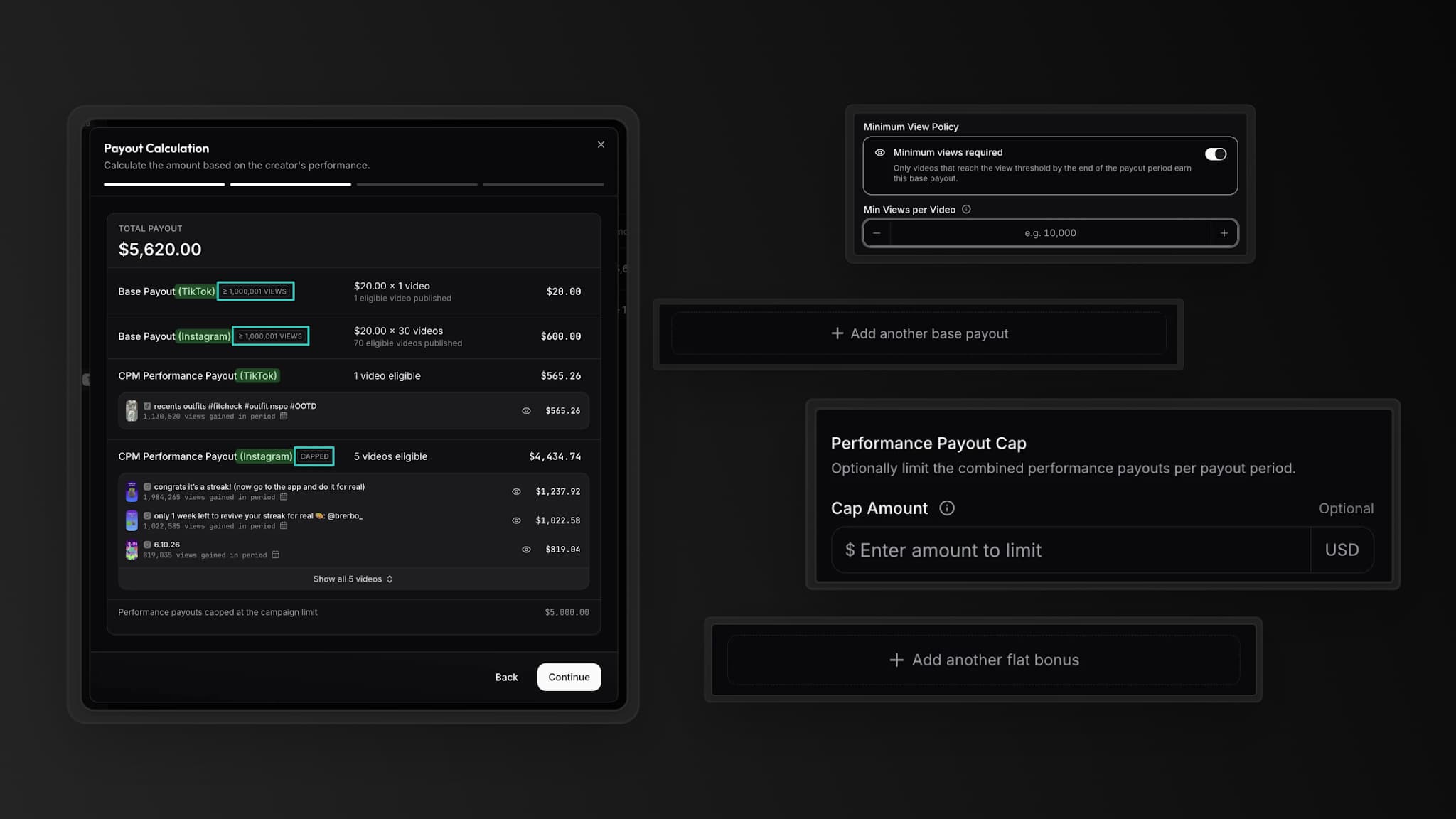
Set platform-specific base rates, CPM and flat bonuses, minimum view thresholds, and spend caps without splitting one creator program into separate campaigns.

Mike Schneider
Co-Founder
Read your campaign's pay rules, see what's guaranteed, and know which videos and views count toward each payout.
Mike Schneider
Co-Founder
Try without risk with our 7-day free trial.
Hire based on data, not by luck.
Pay everyone on your own terms.
Eliminate hours of manual work.
Pay $0 today · Cancel anytime · I'm a creator