| What matters | Traditional UGC | Canvas UGC |
|---|---|---|
| How the creator gets paid | One flat fee per video | Monthly base pay + bonuses for views or sales |
| Risk for the brand | High (paying upfront for unknown results) | Lower (spend scales with results) |
| The main goal | One polished video | Many raw, reusable clips to test |
Short-form content is no longer just about creators building their own audience. A new model is changing how brands publish, test, and scale their videos, and it's reshaping how creators think about their work.
For brands, this provides a faster way to meet content demand, and for creators, it offers a new opportunity that is not tied to follower count. So what exactly is Canvas UGC, and why are more teams and creators talking about it now?
What is Canvas UGC
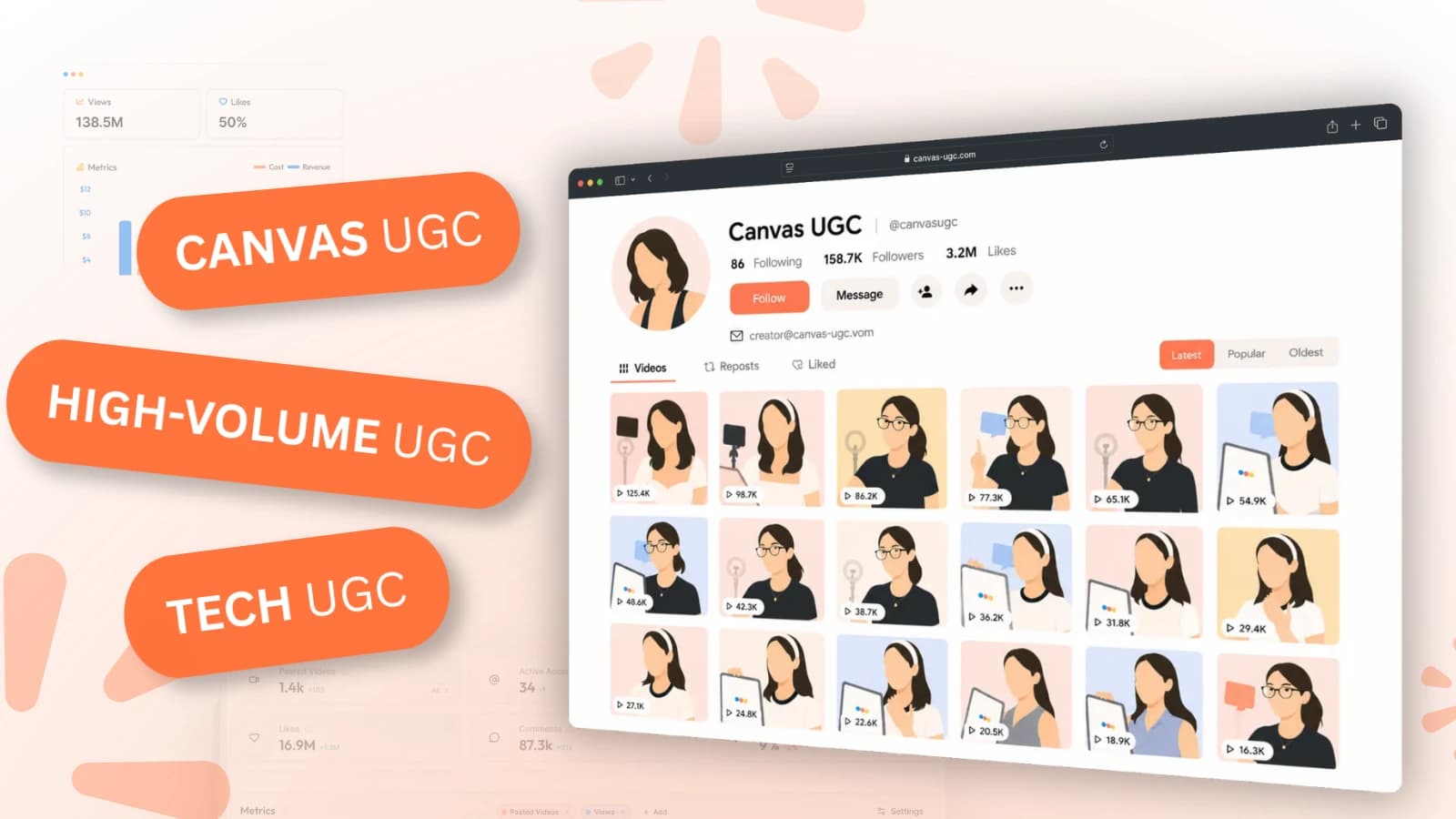
Canvas UGC (sometimes written ugc canvas) is a content production model where an external creator scripts, films, edits, and publishes short-form video on a brand’s social account rather than the creator’s personal page. Mackenzie Marsh originally coined this term on TikTok.
Instead of simply delivering a finished video asset, creators produce and publish content directly for brand-owned accounts, and compensation is often tied to performance.
You might also see this content production model referred to as Tech UGC, High-Volume UGC, or brand account UGC, depending on who's using the term and the aspect they want to highlight.
- Tech UGC is typically used to create content for technology companies or platforms, often focusing on product demos or software walkthroughs.
- High Volume UGC emphasizes the scalable, rapid-production nature of this approach, where brands commission many videos to test or use across campaigns.
- Brand account UGC highlights that the content is published to the brand's official social channels rather than the creator's personal feed.
While all of these terms refer to similar strategies, each one highlights a slightly different angle of the larger Canvas UGC model. This variety of names can sometimes confuse, but the core idea remains the same.
How Canvas UGC works
Canvas UGC usually starts with a brand opening a campaign and inviting creators to apply, either through a platform or directly. Once the creator is accepted, they create a new account, usually on TikTok, or get access to the brand's account/posting setup.
In many cases, the account is designed to appear like a regular user profile rather than a traditional branded page.
From there, creators produce organic short-form videos featuring the brand’s product or service and publish them directly to the account. The goal is to create content that feels native to the platform while giving brands a steady stream of videos to test across different hooks, formats, and audiences.
Canvas UGC vs traditional UGC
Both models involve creators producing content for brands, but their structures are different.
Traditional UGC is typically created as an asset for the brand to use in ads, websites, or other marketing channels. In contrast, with Canvas UGC, the creator may set up the account, but it operates as the brand’s channel, and content is posted directly to it.
The main difference is in how the content is stored and used. In traditional UGC, the creator provides a video file and receives payment for the content. With Canvas UGC, the content is published directly to a brand-controlled account, and creators are often compensated based on performance (such as views, installs, or conversions) rather than a flat project fee.
The workflow is also different. Traditional UGC is often handled as a one-off project, while Canvas UGC is designed for higher volume, with creators making and posting multiple short-form videos over time.
Pay changes too. Traditional UGC usually pays a flat $150 to $500 per video, whether it gets 10 views or 10 million. Canvas UGC programs often pay a monthly base (a median of $500 a month on live UGC jobs in October 2026) to secure the creator's time and raw footage, plus performance bonuses when a video crosses view milestones such as 100k, 500k or 1 million views, or when it drives sales through a tracked link or discount code.
The process is built for volume, not for one-off posts. Many brands produce dozens of videos each month, making tracking, attribution, and payouts critically important as the program scales.
Why brands use it
Brands use Canvas UGC because it offers more content without relying on a single creator post or a slow production cycle. It is especially useful for consumer apps, SaaS, AI, and other digital products that need a constant stream of short-form video to test hooks, angles, and formats.
Another reason is control. Since the content is published on the brand’s own account, brands can build a repeatable channel instead of renting attention from someone else’s audience.
Brands planning a first pilot can start with the free Canvas UGC Launch Kit, a Notion template with a creator roster, launch gates and a 12-step checklist.
Why do creators like it
Canvas UGC has become attractive to creators because it lowers the importance of audience size. Instead of depending on a large personal following, creators are valued more for their ability to make engaging short-form content that performs well.
For newer creators, that can make it easier to work with brands without spending years building a personal audience first. Skills like strong hooks, editing, storytelling, and an understanding of platform trends can matter more than follower count alone.
But it can also lead to more consistent work. Since brands often need a steady flow of videos for testing, creators may keep producing content over time instead of relying on one-off sponsorships.
Common misconceptions
As Canvas UGC becomes more popular, it’s also becoming widely misunderstood. Some people see it as an easy way to make money online, while others dismiss it as low-quality content work with no long-term value.
In reality, Canvas UGC is closer to a volume-based content business than a traditional influencer model. Success usually comes from consistency, testing, and understanding platform performance rather than relying on a single viral video.
- “It requires no effort and makes you rich instantly.”
One of the biggest misconceptions is that Canvas UGC is passive income or an easy shortcut to making money online. In practice, the model is built around high-volume content production. Many creators produce multiple videos per day across different accounts, which requires scripting, filming, editing, testing, and account management on a consistent schedule.
Like most performance-based systems, results tend to come from repetition and optimization rather than overnight success.
- “You need a huge following to get started”
Unlike traditional influencer marketing, Canvas UGC usually places less importance on audience size.
Brands are typically looking for creators who understand short-form content, platform trends, and conversion-focused storytelling. In many cases, creators work on newer or smaller accounts where performance matters more than follower count.
The ability to create videos that retain attention or drive installs can often matter more than having a large personal audience.
- “It damages your personal brand”
Some creators worry that producing high-volume content for brands could hurt their personal identity online.
In reality, the creators separate Canvas UGC from their personal presence entirely by using secondary or niche-specific accounts. This allows them to experiment with different formats, industries, and creative approaches without affecting their main profile.
For many creators, these accounts also become proof of performance that can later be used as a portfolio when negotiating with brands or agencies.
How to get started
Canvas UGC lowers the barrier to entry because you do not need a large following to begin. What matters most is your ability to make short-form videos with strong hooks, clean editing, and enough consistency to keep testing what works.
The easiest way to start is to choose one or two niches that you can film naturally, such as apps, AI, study, fitness, or finance. From there, create a small portfolio by recreating a few viral short-form videos in that space so brands can quickly see your style and execution.
Once you have that, sign up as a creator on viral.app's Canvas UGC marketplace, apply to open jobs matched to your country and languages, and be ready to accept posting access when you get approved. The goal is to start producing content regularly, since many brand canvases expect ongoing volume rather than one-off posts.
A modern smartphone, decent natural light, and a free editing app are usually enough gear to begin. In the day-to-day, most Canvas UGC creators script a hook, film a short video, edit it in a native style, post it on the brand’s account, and then repeat the process.
What Canvas UGC looks like in practice
Sprout
Sprout is a good example of Canvas UGC in the career space. Its creator content uses job-search frustration, burnout, layoffs, and awkward interview situations to make the product feel like a natural part of the conversation.
The videos usually start with a problem job seekers already know, then introduce Sprout as the thing that makes the process easier. That makes the content feel native and easy to relate to.
Sprout also works well as a testing system, since different creators can try different hooks and workplace scenarios to see what gets the most attention.
SpoilMe
SpoilMe shows a different but equally clear version of Canvas UGC. The creators posting about it build the content around wishlist fantasy, personal storytelling, and the idea of getting gifts or attention through a public wishlist.
What stands out is that the content feels casual and creator-led rather than branded. The videos use familiar selfie-style framing, simple text overlays, and a tone that sounds like someone sharing a personal experience instead of promoting a product.
That is what makes SpoilMe blend naturally into the feed and shows how Canvas UGC can work well outside edtech or career content.
Knowunity
Knowunity provides a great example of Canvas UGC as the creators always focus on the issues faced by students, especially exam stress, and the sense of accomplishment when graduating with the help of the app.
The videos do not try to explain the product like software. Instead, they start with a very specific student emotion, such as being behind, struggling with math, or needing help before a test, and then present Knowunity as the free tool that makes the situation easier.
That is what makes the content feel native to TikTok and especially effective in StudyTok, because the app is framed less like a platform and more like a rescue tool.
Bottom line
Canvas UGC is not just another creator trend. It is a performance-driven way for brands to scale short-form content while giving creators a path that depends more on skill and execution than on follower count.
What makes it powerful is the combination of native-feeling content, high-volume testing, and clear performance goals. When it works well, the content does not feel like an ad, and the comments, views, and reactions become part of the growth system.
Brands like Sprout, Knowunity, and SpoilMe show that this model can work across very different niches. The common thread is simple:
- start with a real problem or desire
- keep the content native to the platform
- and let the product appear as the answer
Track the creator program behind Canvas UGC
If you are running Canvas UGC across several creators, accounts, or brand campaigns, the hard part is not just publishing more videos. It is knowing which posts worked, which creators deserve more budget, and which payouts match real performance.
The finding part is covered too. Brands can post a Canvas UGC job on viral.app's creator marketplace and review applications that arrive with portfolio videos, connected accounts, languages, and location. Creators can sign up, build a profile once, and apply to jobs matched to their country and languages.
Create a viral.app account to hire creators, monitor their posts, and run performance-based payouts, or use the social media campaign reporting guide to plan the reporting setup first.