| High-volume campaign goal | What it means |
|---|---|
| Creative testing | Producing many variations to quickly see which hooks, angles, and formats perform best |
| Scaling winners | Taking the best-performing concepts and turning them into more creator versions |
| Audience insight | Learning which messages, creators, and formats resonate with different segments |
| Content velocity | Generating enough assets to keep testing and avoid creative fatigue |
| Format validation | Checking which video structures, lengths, and styles work consistently across creators |
A successful UGC campaign is not only about collecting videos. It is also about building a repeatable system that uses multiple creators, tests quickly, and scales the best-performing angles.
The strongest campaigns combine creator diversity, high-volume production, competitor tracking, and a clear process for doubling down on what works. High-volume UGC is especially effective because it helps teams test more hooks, reduce creative fatigue, and scale proven winners faster.
The five-step system
Define the goal, build a diverse creator pool, produce structured variations, track market patterns, and replicate the combinations that keep winning.
Define the campaign goal
Pick the learning goal first: creative testing, scaling winners, audience insight, content velocity, or format validation.
Use multiple creators
Build a pool with different styles and levels of polish so every post becomes a comparison point.
Produce high-volume variations
Brief several versions of each concept and change one variable at a time: hook, intro, proof, CTA, length, or pace.
Track competitors
Watch which hooks, formats, and creator types keep reappearing in your niche before writing the next brief.
Double down on winning patterns
Multiply the structure behind the winner across more creators, cuts, and accounts until performance flattens.
1. Define the campaign goal
Before anything else, decide what the campaign is supposed to achieve. If the goal is unclear, everything else becomes harder: the brief, creator selection, content style, and performance tracking.
A campaign with this kind of goal is much easier to manage because every asset has a role in the learning process. Instead of asking, “Did this one video go viral?” you are asking, “What pattern can we repeat across more creators?”
2. Use multiple creators for diversity
A high-volume UGC program works best when it uses multiple creators, because different creators bring different tones, faces, pacing styles, and storytelling instincts.
That variety gives you more material to test and helps you understand whether the message, the creator, or the format drives performance.
One perfect creator cannot tell you that. A mixed pool can, because every additional style turns the next post into a comparison point.
A strong creator pool usually includes:
- Creators with different delivery styles, from direct-response to conversational.
- Creators with different levels of polish, from raw and relatable to more structured and clean.
- Creators who can repeat formats reliably, which matters when you want more than one-off content.
In a high-volume system, creator diversity is valuable because it creates comparison points. If one hook works across five creators, you have a much stronger signal than if it only works with one person.
3. Produce high-volume variations
This is where the campaign becomes a real testing engine. Instead of asking each creator for one finished deliverable, brief them to create multiple versions of the same core idea so you can test different hooks, intros, proof points, CTAs, and lengths.
The creative itself deserves this effort. In NCSolutions' meta-study of nearly 450 CPG campaigns, creative quality drove 49% of incremental sales, more than targeting, reach, and recency combined. High-volume production is how you keep finding better creative: change one variable at a time, at scale.
For example, if one creator makes a testimonial-style video, you might ask for four more cuts:
- A faster hook.
- A stronger objection-handling version.
- A version with a different CTA.
- A shorter edit for retargeting.
That kind of structure makes it easier to spot repeatable winning patterns and avoid wasting time on random creative changes.
4. Track competitors in viral.app
Competitor tracking helps you understand what is already working in your niche, which makes your testing smarter and faster. Instead of guessing which formats might perform, you can look at the creative signals competitors keep repeating, such as hooks, creator styles, and message angles.
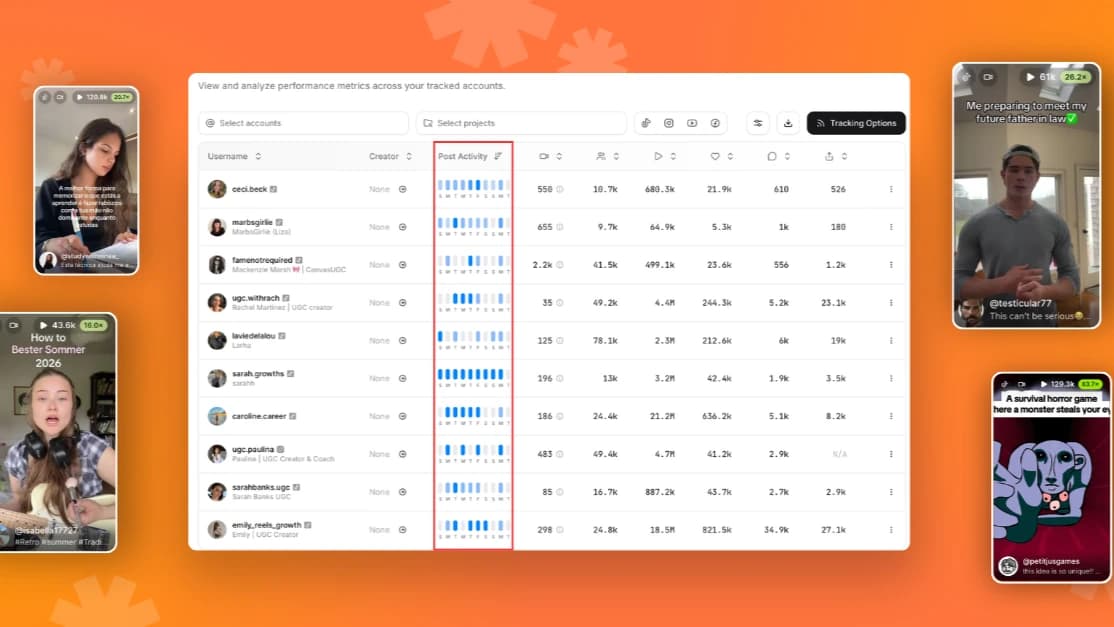
In viral.app, competitor tracking is especially useful because it lets you keep competitor analysis separate from your own content performance, so your insights stay organized.
What to look for:
- Repeated content angles.
- Top-performing formats.
- Creator types that are used again and again.
- Messaging patterns competitors lean on.
- Creative gaps you can test differently.
Treat this as market research, not a template to copy. Competitor patterns show where the market's attention already is; your job is to brief a sharper version of what has proof behind it.
5. Double down on winning patterns
Once a pattern starts winning, the goal is to multiply it quickly. In a high-volume UGC program, the real asset is the structure behind the winner — the hook style, creator type, proof point, or CTA — more than any individual video.
The best teams move from testing to replicating as soon as they see a reliable signal.
Ways to double down:
- Keep the same hook but change the creator.
- Keep the same message but change the intro.
- Keep the same proof point but test different CTAs.
- Turn one winner into several shorter and longer edits.
- Recreate the same format with different personalities.
This is how campaigns become scalable. Instead of chasing a new idea every time, you build more assets from the same proven structure until performance starts to flatten.
The bottom line
A strong UGC campaign is built like a learning system, not a content one-off.
If you define the goal around testing and scaling, use multiple creators, produce high-volume variations, track competitors in viral.app, and double down on what works, you create a campaign that gets smarter with every round.
Run that loop for a few cycles and it compounds: every round of results makes the next brief better informed than the last. The free UGC course for brands covers the full setup, through a 90-day plan.
How viral.app can help
If you are running high-volume UGC, the hardest part is usually not making one video. It is keeping track of many videos, many creators, and many results at the same time. That is where viral.app can make the workflow much easier.
viral.app is built for UGC marketing and creator campaign management. It lets teams track content performance across TikTok, Instagram Reels, YouTube Shorts, and Snapchat Spotlight in one place, so you do not have to jump between platforms or rely on messy spreadsheets.
It also helps with creator payouts, reporting, and campaign monitoring, which matters a lot once the number of posts starts growing.
Here is where it helps most:
- You can track creator posts and campaign results from one dashboard.
- You can compare which hooks, formats, and creators are performing best.
- You can manage payouts more cleanly when campaigns are based on results.
- You can keep an eye on competing accounts and content patterns.
- You can organize a larger creator program without losing visibility.
For teams that want to grow through high-volume UGC, that kind of structure matters. It gives you a clearer view of what is working, what is not, and where to put more budget next. You can test it on a live campaign with a 7-day free trial and cancel anytime.
Frequently asked questions
A high-volume UGC campaign is a structured creator program that produces enough videos and creative variations to test hooks, formats, messages, and creator styles quickly. The goal is not volume for its own sake, but faster learning and repeatable winners.
There is no universal number. Start with enough creators to compare different delivery styles and test the same core concepts more than once. Scale the roster when your brief, review process, tracking, and payout workflow can support more output without losing visibility.
Useful variables include hooks, intros, problem-solution framing, product demonstrations, social proof, calls to action, video length, and editing pace. Change variables deliberately so you can tell which difference affected performance.
Scale when the underlying pattern looks repeatable, not only when one post performs well. A hook, proof point, or format that works across multiple creators, cuts, or repeated posts is a stronger signal than a single outlier.