
Short answer
High-volume UGC helps paid ad teams create enough distinct hooks, formats, and creator voices for Meta and TikTok to find winners before creative fatigue sets in.
Try without risk with our 7-day free trial.
Hire based on data, not by luck.
Pay everyone on your own terms.
Eliminate hours of manual work.
Pay $0 today · Cancel anytime
Try without risk with our 7-day free trial.
Hire based on data, not by luck.
Pay everyone on your own terms.
Eliminate hours of manual work.
Pay $0 today · Cancel anytime
Try without risk with our 7-day free trial.
Hire based on data, not by luck.
Pay everyone on your own terms.
Eliminate hours of manual work.
Pay $0 today · Cancel anytime
Pay $0 today · Cancel anytime
Book a demo and see how it would run for your brand.
Hire based on data, not by luck.
Pay everyone on your own terms.
Eliminate hours of manual work.
Pick a time · No commitment
Pick a time · No commitment
Try without risk with our 7-day free trial.
Hire based on data, not by luck.
Pay everyone on your own terms.
Eliminate hours of manual work.
Pay $0 today · Cancel anytime
Try without risk with our 7-day free trial.
Hire based on data, not by luck.
Pay everyone on your own terms.
Eliminate hours of manual work.
Pay $0 today · Cancel anytime
Paid social performance is now more limited by creative than by media budgets or bidding methods. High-volume user-generated content(UGC) gives ad platforms a wider variety of trustworthy, native-feeling materials, which improves:
By consistently producing and testing many UGC variations, brands align with how Meta, TikTok, and similar platforms optimize delivery. Their AI systems favor advertisers who provide a broad range of unique creatives that can be matched to different audiences in real time.
This turns UGC from a simple asset into a key part of a strong paid ad strategy.
On Meta and TikTok, targeting, bidding, and placements are now mostly automated. What really affects performance is the ad itself, its hook, angle, and format. Meta explicitly highlights that “creative diversification” is a main way to improve results in its AI-powered ads system.
More diverse creatives give the algorithm more chances to reach new audiences and improve outcomes.
Internal and third-party analyses show that UGC-style ads often drive 3 to 5 times better conversion metrics than polished brand creatives. This highlights how much performance depends on the ad itself.
When a brand relies on only a few creatives for each campaign, the algorithm's ability to identify successful ones is limited. A single weak creative can drag down overall performance. This risk is especially heightened in performance-driven settings where CPMs are increasing, as each impression must justify its expense more effectively.
Before you pay to push a video in front of strangers, you want proof that it can actually hold. Since paid ads are expensive, organic short‑form UGC is the most affordable and realistic way to test that first.
On TikTok, Reels, and Shorts, a strong video can go far beyond the creator’s follower count when the hook and watch time are good. A creator with a few hundred followers can still reach tens or hundreds of thousands of views if:
This is the key asymmetry between paid and organic:
With high‑volume organic UGC, you let the algorithm and the audience do the filtering. Most videos will perform “normally.” A few will break out. Those organic outliers are your most valuable signals and your best paid assets.
It is not enough to say “UGC works better than studio.” Within UGC, small differences create big performance gaps. Let's take a look at some examples:
Those nuances are what the algorithm is actually optimizing between. The more distinct, high‑quality UGC variants you produce, the more chances you give the system to find combinations that deliver low CPMs and strong downstream metrics.
High‑volume UGC is not “making a lot of random videos.” It is a structured way to discover your best creatives.
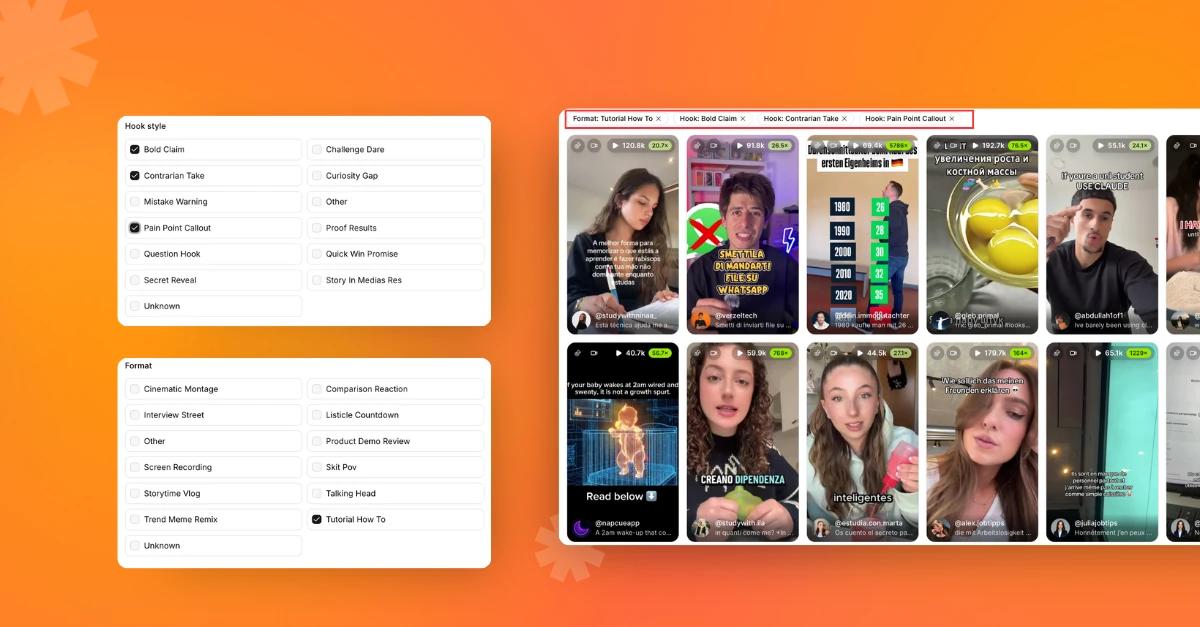
You specifically brief multiple creators on different hooks, angles, and formats, let those videos compete organically, and only push the proven winners into your paid ad sets. Thus, the volume is not the goal itself; volume is how you turn UGC into an organized discovery engine for low-CPM and high-conversion ads.
The most effective loop starts in organic and ends in paid. You first let many UGC videos compete for attention without a budget, then you only spend behind the few that clearly win.
Brief multiple creators across different hooks, angles, and formats so the audience can reveal what actually earns attention.
Compare reach relative to audience size, watch time, completion, saves, shares, comments, and questions before spending.
Keep the winning hook and structure intact, secure usage rights, and launch the content as Spark Ads, Partnership Ads, or standard UGC ads.
Use paid performance data to write sharper briefs, duplicate winning angles, and test new creator voices around the same idea.
Once a lot of the UGC content is live on the creator accounts, your job is to watch which videos actually take off without spending. Look at:
These signals tell you which hooks, angles, and formats are strong enough to deserve budget.
Next, you turn those organic hits into actual ads:
You are not reinventing the concept, you are simply giving a proven piece of content more reach.
Once these creatives run as ads, you use performance data to push the system further:
In this model, organic UGC acts as the filter, while paid UGC serves as the amplifier. Instead of guessing which creative to boost, you scale the content that has already gained attention organically and then enhance it with paid promotion.
When you put all of this together, the picture looks very different from a traditional “paid media” approach:
Paid ads are no longer just about media buying, but they are about building a creative system where organic and paid UGC work together:
In a world where platforms handle targeting and auctions, that system, rooted in high‑volume, high‑quality UGC, is what ultimately saves your paid ad strategy.
Running high‑volume UGC is less about finding “one great creator” and more about running a system: recruiting many creators, sending clear briefs, collecting dozens of videos, tracking how each one performs, and then deciding which to scale in paid.
Once you have 50, 100, or 200 creators posting regularly, coordinating all of that through spreadsheets, DMs, and shared drives quickly becomes the bottleneck, not creative ideas.
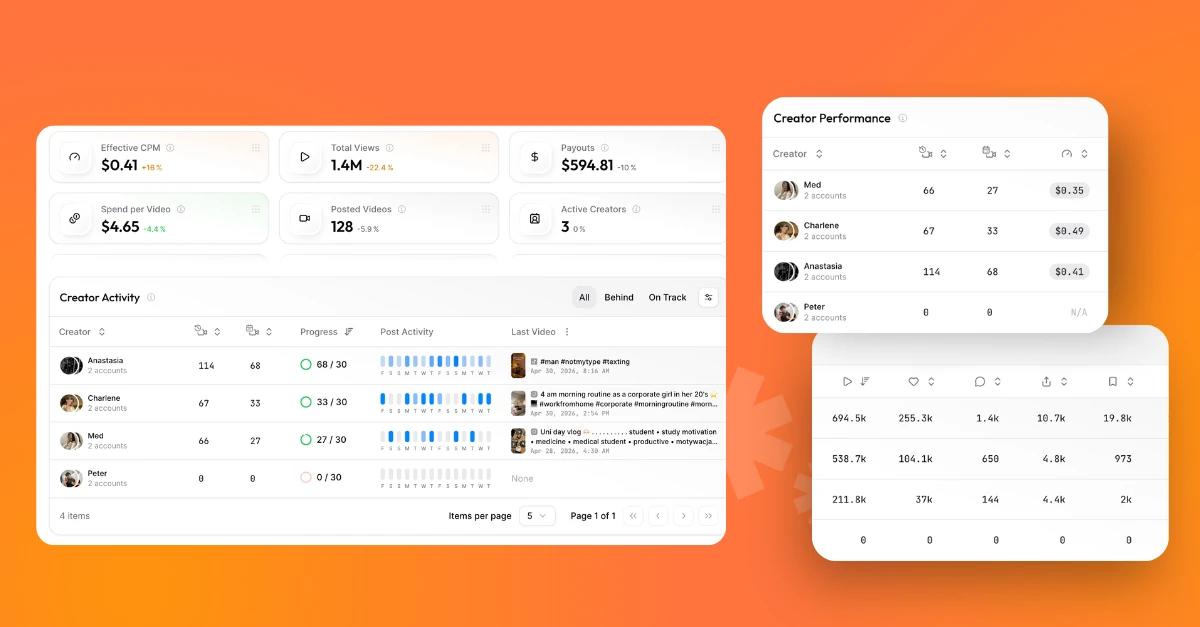
A platform like viral.app helps by centralizing the workflow around high‑volume UGC: you can manage creators and briefs in one place, collect and store all the videos, and see performance at the level of individual assets instead of only at channel level. That makes it easier to:
In other words, if you want high‑volume UGC to function as a discovery engine for your best creatives, you need more than “a lot of videos”, you also need infrastructure to keep the volume organized, measurable, and usable.

Learn how systematic creator tracking connects content, performance, attribution, and payouts as high-volume UGC programs scale.

Mike Schneider
Co-Founder
A practical five-step system for producing more creator content, testing structured variations, and scaling the patterns that perform.
Mike Schneider
Co-Founder
Try without risk with our 7-day free trial.
Hire based on data, not by luck.
Pay everyone on your own terms.
Eliminate hours of manual work.
Pay $0 today · Cancel anytime