Why UGC creator tracking is essential for high-volume creator programs
Learn how systematic creator tracking connects content, performance, attribution, and payouts as high-volume UGC programs scale.
Written by
PublishedAugust 16th, 2026
UpdatedSeptember 29th, 2026
Creator programs used to mean managing a handful of creators. Many brands now coordinate dozens or even hundreds who post on an ongoing basis, and the supply side keeps growing: Goldman Sachs Research counts roughly 50 million creators worldwide and expects the creator economy to nearly double from $250 billion to $480 billion by 2027.
More creators and more content mean faster creative testing. They also mean more moving parts, and that is where programs break: past a certain volume, nobody can say from memory which creators or videos actually earn their budget. Tracking is what keeps that answer available.
Quick answer
UGC creator tracking gives high-volume programs one record for creators, assets, campaign status, performance, attribution, and payouts. Without it, more content creates more operational noise. With it, teams can identify repeatable winners and scale them faster.
Tracking high-volume creator programs
A high-volume program flips the usual ratio: instead of a few creators making a handful of polished assets, many creators produce a continuous stream of videos for testing and distribution.
Several creators can work the same product or angle at once, so the brand tests different hooks, formats, and styles in parallel and scales the winners across paid and organic channels.
For example, instead of asking one creator to produce three videos, a high-volume creator program might work with 50 creators, each producing three to five variations around the same product. That is hundreds of assets per testing cycle.
Unlike influencer campaigns, where the creator's audience size carries much of the result, high-volume programs bet on the content itself. Each video is one test in a larger series, and the next brief is written from the results.
The catch is coordination. Onboarding, submissions, approvals, revisions, usage rights, campaign assignments, and reporting all multiply with every new creator, across hundreds or even thousands of deliverables. Past a certain volume, spreadsheets stop answering the two questions that matter most: who is performing, and what should we make more of?
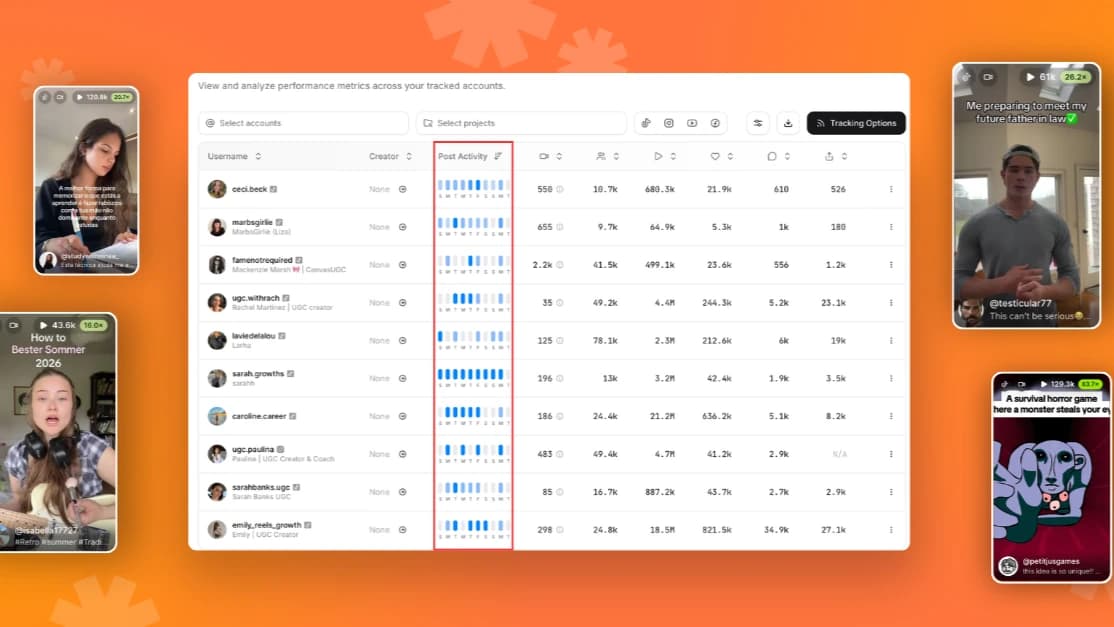
A centralized account view helps teams compare creator output and performance without rebuilding the report in a spreadsheet.
Benefits of systematic UGC tracking
Every creator, asset, and campaign produces data. Tracking is what turns that pile of numbers into decisions.
Identifying high-performing creators
In any large program, a small group of creators delivers most of the results. With standardized metrics, you can see who that group is and send them more briefs and budget. Without them, budget follows gut feeling and whoever posted most recently.
Optimizing creative through volume
Volume only pays off when you can read the results. If 50 videos share a hook style and 40 of them beat the account average, that hook belongs in the next brief. Tracking makes those patterns visible instead of anecdotal.
Managing operational scale
Creator status, deliverables, revisions, approvals, contracts, payments, usage rights: each is easy to follow for ten creators and painful for a hundred. A central system keeps operational management and performance reporting in one place, so the team spends its time acting on numbers instead of reconciling them.
The cost of skipping this is quiet. Underperforming creators and concepts keep getting budget simply because nobody can prove they should not.
Implementing a UGC tracking infrastructure
The system does not need to be complicated, but it does need to connect creators, content, and results in one place. A workable setup covers four surfaces:
Creator management
Onboarding, communication, deliverables, approvals, and payments in one record per creator.
Content library
Every asset organized by creator, campaign, and production status.
Attribution
Tracking links, promo codes, or integrations that connect content to business outcomes.
Performance reporting
Views, engagement, clicks, and conversions for every asset in one dashboard view.
The minimum tracking model
A useful tracking framework should answer four questions without requiring a manual reconciliation project.
The exact metrics depend on the campaign objective. A view-based organic program needs a different scorecard from a conversion-led paid program, but both need consistent definitions and a traceable link between creator activity and the result being measured. A social media ROI framework helps keep those definitions consistent across campaigns.
Bottom line
A high-volume program without tracking just produces more content. With tracking, it produces answers: which creators to rebook, which hooks to rebrief, and where the next dollar should go.
How viral.app can help
Running high-volume UGC means tracking hundreds of videos across multiple brand accounts and seeing which hooks, angles, and formats hold up. viral.app is built for exactly that job.
"We are tracking close to 100k videos with viral.app. It's been super reliable and a big help in
scaling our UGC program into one of the biggest in the world."
Matthew GittlesonJenni AI Growth
For performance-driven UGC, it helps you:
Track all creator videos in one place: Paste any public TikTok, Instagram Reels, YouTube Shorts, Facebook Reels, or Snapchat Spotlight link and track views, engagement, posting schedules, and campaign performance without needing creator logins.
Organize videos by tags and themes: Use AI-assisted tags to classify videos by format, hook, or angle, so you can group content by your test clusters, such as “POV hooks,” “before-and-after demos,” or “speed vs. simplicity.”
Track competitors and spot winning formats: Monitor competitor brand accounts to see which topics and formats are gaining reach and engagement, then adapt those patterns for your own creator program.
Manage payouts based on performance: Set base fees, CPM tiers, milestone bonuses, or a mix of them, and use the same tracked results to calculate and review creator payouts.
For teams running high-volume UGC, viral.app's UGC analytics platform becomes the infrastructure for tracking performance, organizing content by format and intent, and doubling down on the hooks and angles that drive consistent results. You can try it on your own accounts with a 7-day free trial and cancel anytime.
Frequently asked questions
UGC creator tracking is the process of organizing creator, content, campaign, performance, attribution, and payout data in one system. It lets teams evaluate both operational progress and the business impact of each creator and asset.
High-volume programs create too many creators, assets, approvals, usage-rights records, metrics, and payout decisions for manual reporting to remain reliable. Systematic tracking creates a shared record and makes repeatable winners easier to identify.
At minimum, track creator activity, posting cadence, asset status, views, engagement, hook or format tags, campaign assignment, payout terms, and payout status. Add clicks, conversions, revenue, or other attributed outcomes when the campaign setup can measure them reliably.
Yes. Public account and video URLs can support cross-platform performance tracking without asking creators for social credentials. Separate attribution links, codes, or integrations may still be needed when the program must connect content to downstream business outcomes.