Quick definition
Canvas UGC is the distribution layer, Tech UGC is the buyer/category layer, and High-Volume UGC is the operating model. In a scaled program, those layers usually work together instead of competing with each other.
Canvas UGC, Tech UGC, and High-Volume UGC are often presented as three separate approaches. In reality, there are three layers of the same scalable UGC model that brands can use to build and grow their UGC programs.
Each label just highlights a different part of the system: Canvas focuses on where the content is posted, Tech on who buys it, and High-Volume on how the process works.
All three layers often work together in practice:
Creators post on brand-controlled accounts (Canvas UGC).
The content is built for tech brands and digital products (Tech UGC).
The program runs at high volume to generate a constant flow of native short-form content (High-Volume UGC).
Compensation is typically performance-linked (CPM per 1,000 views or CPA per install/conversion), sometimes with a base or retainer layer. The model is used most often by apps, SaaS, and AI tools that need a steady stream of native short-form content.
This combined approach is not the norm for most brands, but it is the best way to create a scalable UGC program. Instead of treating these as three separate strategies, think of them as one full UGC model with three layers.
Brands that want to scale their UGC programs can combine Canvas UGC, Tech UGC, and High-Volume UGC to produce more content while keeping quality and costs under control.
You don’t need a tech product to use Canvas UGC and High-Volume UGC. Those two layers are about how you post and how you scale, not what you sell.
Canvas UGC still means creators post on your brand account (or brand-funded canvas), not their own.
High-Volume UGC still means you produce many assets, test hooks, and iterate fast.
In Canvas UGC, the brand’s profile is the canvas. The core definition: user-generated short-form content posted directly on a brand’s own social accounts, with creators compensated for the results those posts generate (views, installs, or other agreed KPIs).
Instead of trying to build a personal audience and sell sponsorships, the creator plugs into a brand account and treats it as their distribution engine.
The brand account might be the main corporate TikTok, a niche sub-brand, or a purpose-built profile designed to look like a native “theme” page.
Tech UGC uses the same mechanics but narrows the category: apps, SaaS, AI tools, games, and other digital products. The content’s job is to show a product in motion, fit into a workflow, and remove friction from understanding what it does.
Independent creators create this type of content that demonstrates how a tech product works in real-life scenarios, often using walkthroughs, tutorials, and use-case stories instead of physical product shots.
Tech UGC relies on a specific set of creative archetypes that are designed to make software easy to understand, relevant, and immediately useful in real-life scenarios:
Workflow demos: “How I use this app to plan my week,” “3 ways I use this AI tool for studying.”
Before/after problem solving: “Here’s how long this took before; here’s how fast with this tool.”
Feature spotlights and micro-tutorials: single feature, single benefit, shown clearly, often via screen recordings and on-screen annotations.
These formats map perfectly to the Canvas model: creators run or contribute to brand canvases for tech products and feed them with this kind of content at a regular cadence.
In Tech UGC, performance is not evaluated by vanity metrics like raw views or impressions.
Tech buyers focus on how efficiently content moves users through the funnel, from attention to actual product usage. This is clear across three layers of metrics:
View-through rate and watch time serve as proxies for hook strength and narrative clarity. They indicate whether the content captures the right audience early and holds attention long enough to communicate the product’s value.
Click-through rates and deep-link taps measure whether viewers take action. These signals show that the content successfully drives users off-platform to explore the product further.
Installs, signups, and in-app activations are the primary success metrics. These are tracked through attribution setups and tied directly to specific pieces of content, making performance measurable and comparable.
This metric logic defines the expectation behind “Tech UGC.” It is not just about producing clean demos or aesthetic content, but about creating assets that reliably drive measurable outcomes for software products.
As a result, Tech UGC is typically executed within high-volume, iterative systems: multiple hooks, formats, and angles are tested in parallel (often via Canvas-style setups), and winning creatives are scaled based on their ability to convert, not just to attract views.
High-Volume UGC applies the same model at scale, producing content consistently to test different approaches and identify top-performing assets.
These high-volume programs are described as:
Dozens of short-form posts per brand per month (30–100+) across TikTok, Reels, Shorts, and sometimes Facebook Reels.
Multiple creators can "feed" one or multiple canvases, so the output is not dependent on one single face.
Constant experimentation around hooks, topics, and POVs directly related to search terms and interest clusters.
The high-volume approach is a reaction to the fact that a single viral video is rarely enough to create a sustainable acquisition channel, and its success stems from many iterations, not one-off hits.
Many High-Volume programs use a multi-account approach:
Multiple TikTok accounts, each with its own persona, niche, or language.
Different creators and formats across those accounts to avoid algorithmic risk and target audience segments.
Consistent posting and “warm” attitude (engagement with relevant content, comments, trends) to keep every canvas healthy.
With this setup, Canvas UGC is no longer “one brand account, one creator”. It actually turns into a network of canvases and creators, all sharing learnings through a format library.
High-Volume UGC is not based on random ideas. Instead of coming up with something new every time, teams use repeatable elements that they can test and improve over time.
These usually include:
Hook libraries: tested opening lines like “POV:”, “Nobody is talking about…”, or “Stop scrolling if…” that are known to grab attention quickly.
Angle libraries: different ways to present the same product, such as focusing on speed, simplicity, saving money, or solving a specific problem.
Format templates: simple, repeatable video types like “3 tips,” “1 mistake,” or “mini case study” that work well and can be reused.
Instead of guessing what might work, this approach builds on what has already worked and improves it over time.
The economics behind Canvas, Tech, and High-Volume UGC are flexible, but most programs follow a few core models. The key difference from traditional creator deals is that payment is often tied, fully or partially, to performance, not just content delivery.
One common structure is pure CPM (cost per 1,000 views). Creators are paid based on the number of views their content generates on a canvas account.
In most programs, CPM rates are relatively low, typically ranging between 2 and 8 USD per 1,000 views, depending on the platform, audience, and program setup.
Example:
CPM: 4 per 1,000 views
A video reaches 250,000 views
Payout: 1,000 (250 × 4)
This model is simple and attractive for brands because it mirrors paid media buying and can be directly compared to ad CPMs. However, it introduces unpredictability for creators; high-performing videos can generate strong payouts, while average ones may earn relatively little.
Many programs use a hybrid model that combines a fixed base with performance incentives.
Payment is usually weekly or monthly basis for delivering a set number of videos (e.g., 15 videos per week).
Additional earnings come from CPM payouts or bonuses once content passes certain performance thresholds.
This structure balances stability and upside: creators get a predictable income tied to output, while still being rewarded for strong performance. At the same time, brands maintain a level of performance pressure without making payouts variable.
Some programs keep the Canvas or Tech UGC setup but apply more traditional UGC pricing:
Flat payment per video (e.g., 50–500 depending on complexity and experience).
Monthly or weekly retainers tied to a fixed content output (e.g., 250 per week for 15 videos).
In this model, the brand takes on more of the performance risk but gains a stable and predictable content pipeline. For creators, this reduces income volatility and can be easier to manage, especially when working across multiple brand accounts.
While the format (short-form video) may look similar on the surface, Canvas, Tech, and High-Volume UGC operate very differently from influencer marketing and traditional UGC.
The differences show up in where distribution happens, how relationships are structured, and what success is measured against
Even though both models often use similar short-form video formats, they operate in fundamentally different ways. Canvas, Tech, and High-Volume UGC are built as performance systems, while influencer and traditional UGC are primarily campaign and brand-driven.
Understanding that Canvas, Tech, and High-Volume UGC are the same model helps you see the bigger picture:
For creators: You can treat this as a repeatable business, not just one-off gigs. You’re not selling your audience, you’re selling performance-driven content within a system.
For brands: This model works best when treated as a performance channel with its own budget, workflows, and KPIs, not as a subset of influencer marketing.
For teams: Splitting this from traditional influencer or UGC campaigns lets you run faster tests, iterate on formats, and scale what actually converts.
The format may look the same, but the logic is different: one is built for campaigns and impressions, and the other is built for systems and outcomes.
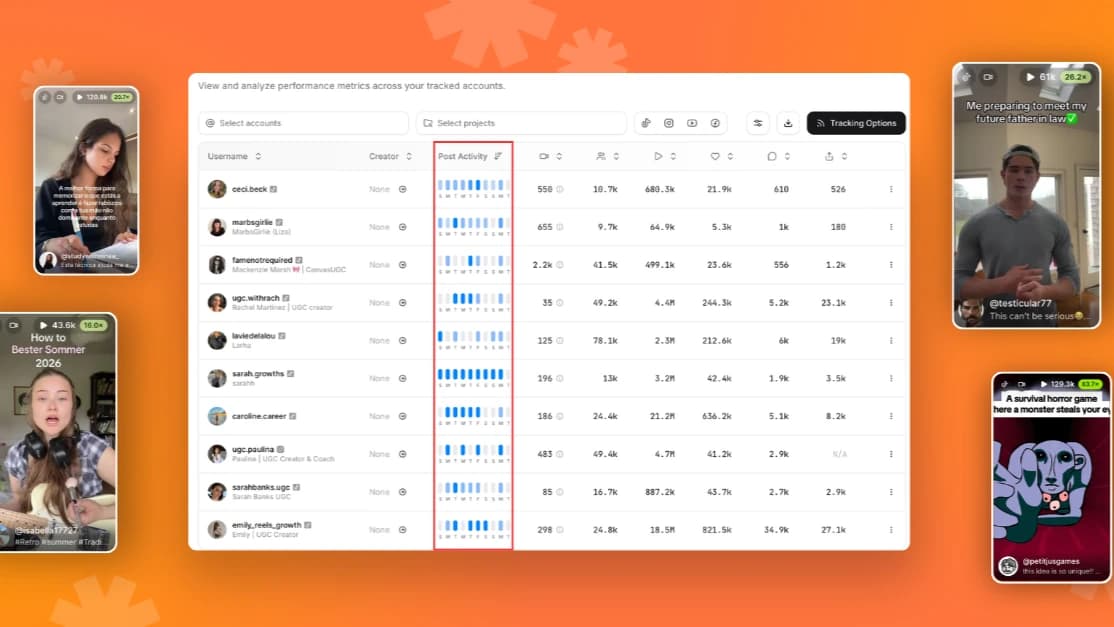
Running Canvas, Tech, or High-Volume UGC means finding enough creators, then tracking hundreds of videos across multiple brand accounts and seeing which hooks, angles, and formats actually drive consistent performance. That’s where viral.app comes in. viral.app is the operating system for UGC marketing.
For performance-driven UGC, it helps you:
Hire creators on the built-in Canvas UGC marketplace Post a job and creators apply with portfolio videos, connected accounts, languages, and location — review applications, chat with applicants, and onboard hires into campaigns without leaving viral.app.
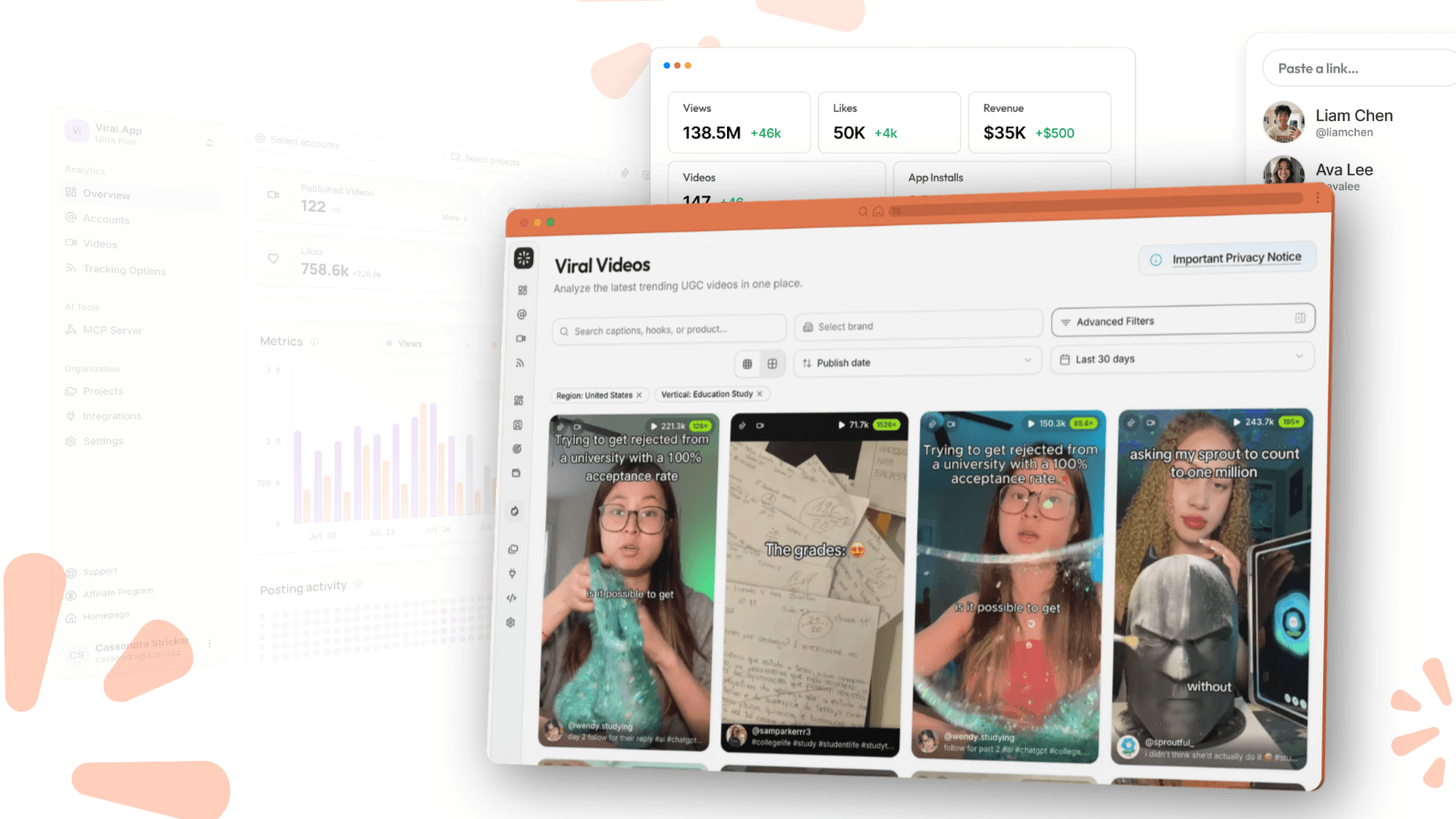
Track all creator videos in one place Paste any public TikTok, Instagram Reels, YouTube Shorts, or Snapchat Spotlight link and track views, engagement, CPM rates, and posting schedules without needing creator logins.
Organize videos by tags and themes Use AI-generated tags to classify videos by format, hook, or angle, so you can group content by your test clusters (e.g., “POV hooks,” “before/after demos,” “speed vs. simplicity”).
Track competitors and spot winning formats Monitor competitor brand accounts to see which topics and formats are actually converting, then adapt those patterns for your own Canvas or Tech UGC program.
Manage payouts based on performance Set CPM, CPA, or hybrid payment models and let the system calculate and process payouts automatically based on actual results.
For teams running Canvas, Tech, or High-Volume UGC, viral.app becomes the infrastructure for tracking performance, organizing content by format and intent, and double down on the hooks and angles that drive consistent conversions.
A practical guide to Canvas UGC, how it differs from traditional UGC, and why brands and creators are using it for high-volume short-form content.

Mike Schneider
Co-Founder
High-volume user-generated content gives paid ad teams more trustworthy creative variations to test, scale, and reuse across Meta, TikTok, and similar platforms.

Daniel Shtabinsky
Growth Analyst
Try without risk with our 7-day free trial.
Hire based on data, not by luck.
Pay everyone on your own terms.
Eliminate hours of manual work.
Pay $0 today · Cancel anytime