How to Make an App Go Viral: Formats, Accounts, Creator Pay and a 30-Day Plan
What it takes to make an app go viral on TikTok and Instagram: which view counts matter, why volume beats one hit, the formats and accounts that worked in our case studies, what to pay creators, and how to see which videos bring installs.
Written by
PublishedNovember 26th, 2026
You make an app go viral by posting short videos every day from several small accounts, then re-shooting the formats that break out. No single video does it. Among about 164,000 TikTok videos from accounts that app teams track in viral.app, 1 in 37 reached 100,000 views, and accounts that posted about once a day had a 100,000-view post in 28% of months.
Views are half of the job. Cluely's founder wrote that one video with 49 million views brought fewer than 100 downloads. So this guide covers both halves: how to get the breakouts, and how to tell which of them bring users. It is about short video, because that is where we have data. Sharing built into the product is the other route, and it gets a short section of its own. Every number comes from our own tracking data or from the case studies linked next to it.
App TikTok videos that reach 100,000 views
1 in 37
2.7% of about 164,000 videos from accounts that app teams track in viral.app. For photo slideshows it is 1 in 64.
Months with a 100K TikTok at 20 to 39 posts
28%
Against 7% for accounts that posted 1 to 4 times in the month.
Downloads from one 49M-view video
Under 100
As reported by Cluely's founder in September 2025.
What does "viral" mean for an app?
For a new app account, one video with 100,000 views is the bar worth planning for, and an app has gone viral when installs rise after videos like that. A million views is the usual shorthand. Across all accounts in our viral view benchmarks, about 1 in 120 TikToks and 1 in 95 Reels get there.
App accounts start a long way from a million. The median TikTok account that app teams track in viral.app has 44 followers, and 83% have under 1,000. Across all tracked accounts of that size, not only app accounts, the median TikTok gets 531 views, the top 1% starts at about 44,000, and about 1 in 1,600 videos reaches a million.
A second test fits any account: compare each video with its account's own median. About 1 in 7 videos gets 3 times the median and about 1 in 20 gets 10 times. The 10x videos are the ones to study and shoot again.
Neither test says anything about installs. That number needs its own tracking, covered further down.
Why isn't one viral video enough?
Views and installs come apart, and you can't pick the hit in advance. Roy Lee, Cluely's founder, described one UGC video with 49 million views and fewer than 100 downloads. His conclusion, which we cover in how Cluely went viral, was that virality gives people a reason to try a product and no reason to stay.
Views are also concentrated. Across 1.7 million TikTok posts tracked in viral.app, the top 1% of videos got 77% of all views. Nobody chooses to land in that 1%, but you can take more shots at it.
Our Canvas UGC playbook for apps shows what a shot is worth. Each post from an app account had a 2.6% to 4.1% chance of reaching 100,000 views, at any posting rate up to about 40 posts a month. The typical post stayed between about 800 and 1,000 views however often the account posted, so what volume buys is more chances at a breakout.
By the month, that adds up. Accounts that posted 20 to 39 TikToks had a 100,000-view post in 28% of those months, against 7% for accounts that posted 1 to 4 times. In the months with a breakout, the best post brought a median 53% of the account's views.
New accounts need patience too. Of new app accounts that reached 30 posts, 29% had a 100,000-view post by then. Of those that reached 60, 44% did. Most accounts stop earlier: only 37% of new accounts got to 60 posts.
Which formats worked for the apps in our case studies?
The posts that traveled opened on a result, a problem or a story the viewer already cared about, and named the app late or only in a hashtag. Here is what carried three apps we studied, and the catch in each case. Where we could check TikTok's ad flag, the table says so.
Open on the viewer's moment. Knowunity's winner sells a rescued grade and explains no feature. Viewers asked for the app's name in the comments.
Answer this week's question. Retro's biggest unpromoted month came eleven weeks after Snapchat announced a cap on free storage. Fast Company reported that by December 2025 Retro was the number one app overall in Germany.
Shoot the winner again. The Knowunity creator posted the comeback format 18 times. The median version got 3.5 times the views of the account's other posts.
Check for the ad flag before you copy. "And it's 100% free" got 5.3 million views on a boosted Knowunity post. The same caption on an unboosted video three days later got 1,190.
To find formats in your own niche, look for a pattern across 5 to 20 videos from different accounts. One viral video on its own is a fluke. Our course chapter on finding viral formats in your niche has a scoring sheet for deciding which patterns to brief.
Slideshows deserve a place in the mix. App teams post them often: 44% of their TikToks are photo slideshows. They are cheap to make, get saved slightly more per view, and reach 100,000 views about 1 in 64 times.
Should you post from a brand account or creator-run accounts?
Run several creator-operated accounts that your app controls, and treat the main brand account as one of them. The setup is called Canvas UGC: a creator films and posts on an account the app owns, usually for a per-video or monthly fee plus pay per view.
App teams already work this way. In August 2026, the median app team we track had 13 accounts posting and published 190 posts that month. The top quarter ran 50 accounts or more. Knowunity says almost everyone in its program posts from a brand-new account with zero followers, and its own US TikTok had 28 videos when we looked.
A new account is no handicap. The median first post on a brand-new app account got 942 views, about the same as a typical post from any app account.
Give each creator their own account, with one angle per account, such as students or budgeting. Our course chapter on briefing and managing UGC creators adds three rules for account health. Warm up a new account for 30 to 60 minutes a day in its niche, and post two casual niche videos before any campaign content. Keep it to 3 active profiles per device. Write every caption fresh, because identical captions across accounts look automated.
Post each video on TikTok and Instagram. The four Cluely episodes we compared got 2.5 to 20 times their TikTok views on Instagram, where Cluely also has about four times the followers. App accounts on Instagram show the same volume curve as on TikTok.
How do you brief, pay and scale creators?
Hire on sample videos, brief from formats that already work, and pay a small base per video plus a bonus for views.
Hiring. The accounts start near zero followers, so a creator's follower count tells you little. Give applicants 48 hours for a short sample task, then run a paid trial of 1 to 2 weeks. On viral.app you post a job with the Canvas UGC type, set the videos per week and review applicants with their portfolio videos.
Briefing. A brief that anyone can execute has 3 to 5 inspiration links, the on-screen text options for the first 3 seconds, a script template by second, the call to action and the pinned comment. Canvas UGC jobs on viral.app ask for a median of 7 videos a week. That puts an account in the 20 to 39 posts a month band.
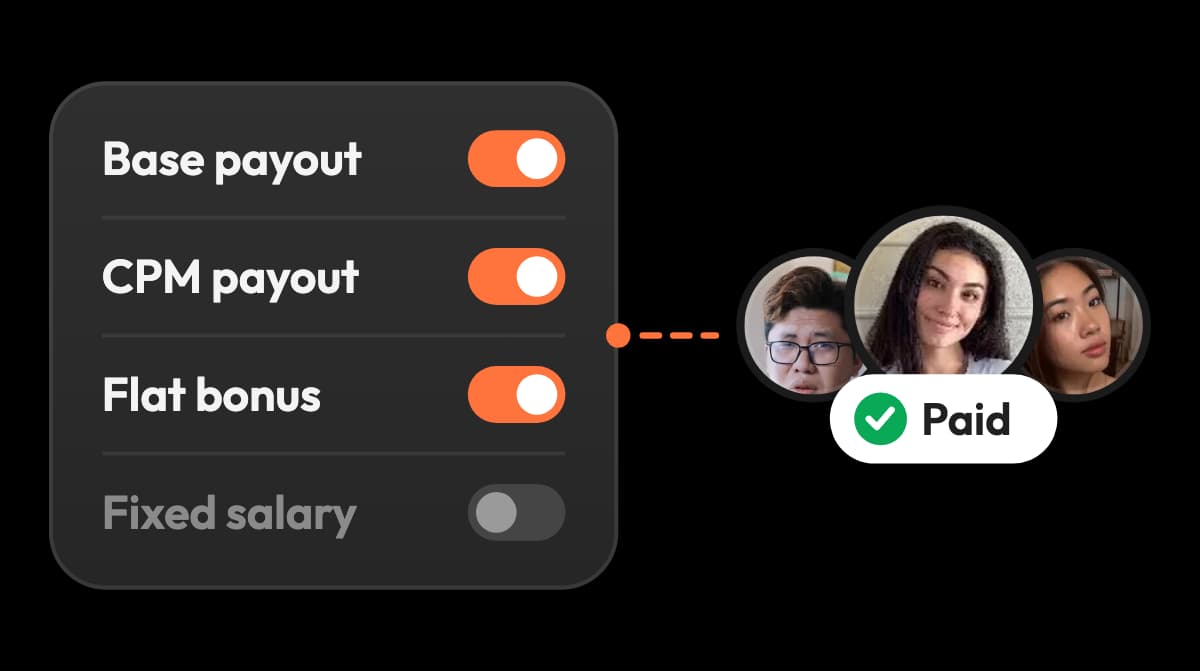
Pay. The deal we recommend to start with is $15 per published video plus a one-off bonus of $100 at 100,000 views, $250 at 250,000 and $500 at 500,000. One video never costs more than $515. Flat-fee UGC often costs $500 or more per video before you know whether it works. Knowunity's program has the same shape: a fixed fee per approved video plus a bonus when it passes a view threshold within seven days. If you add pay per 1,000 views, cap it per video and per payout cycle. The chapter on how to structure creator pay walks through each setting.
What does an account cost? At the median rates in open jobs on viral.app, $15 a video plus $1 per 1,000 views, an account posting about 30 times a month cost about $510 in a median month and about $1,135 in an average one. The starter deal above has no pay per view: 30 videos cost $450 plus whatever bonuses they earn.
Scaling. Views concentrate among creators as well. Lee said 1% of Cluely's clippers produced 99% of the views, so find the few who carry your program and pay them more. Programs tend to stall at 10 to 20 creators when briefs and tracking still run on DMs. viral.app campaigns calculate each payout from the rules you set, and every payout waits for your approval. Creator payouts reach creators in more than 180 countries. You pay a 3% fee on top, and none of it comes out of the creator's pay.
Does the product have to be shareable too?
It helps, and for some apps it matters more than any video. Retro's founders said they marketed the app through things users make and share outside it: recaps on Instagram, postcards in the mail and album links that open without an account. Its best TikToks without the ad flag show the same things. Lee came to a similar view from the other side. After hundreds of millions of views, he wrote that scalable growth has to be product-led.
If your app produces something a user would post anyway, such as a recap, a result or a score, build your first video formats around that output.
How do you tell which videos drive installs?
Line up daily views with daily new customers and trials for each app, then watch the days after a breakout. Install attribution won't settle it. A viewer who sees a creator's post and later searches the App Store usually counts as an organic install.
We can't give you a views-to-installs rate. In our data, the ratio of new customers to organic views varied by more than 100 times between app projects, because store search, paid ads and word of mouth land in the same count. Measure your own baseline: compare the days after a breakout with the same weekdays before it.
Read the comments. Buying questions such as "What app is this?" or "Is this on iOS?" mark a format built for conversion. Jokes and emojis mark entertainment.
Take paid views out. Ad-flagged TikToks above 100,000 views had a median of 4.1 likes per 1,000 views in our data, against 66 for unflagged ones. A boosted view count reflects ad spend, so don't credit the format for it.
Wait a week. TikToks that ended above a million views had a median of 7% of their 30-day views after one day and 63% after a week.
In viral.app, the RevenueCat integration puts App Revenue, New Customers, New Trials and New Paid Subs next to the views of each app's accounts. The Virality Factor column divides each video's views by its account's median, so a 10x post from a 40-follower account stands out. Once a post has broken out on its own, Create Ad turns it into a TikTok Spark Ad or an Instagram or Facebook partnership ad, and app installs can be the goal.
What does a 30-day plan look like?
A month is enough to build the system and get your first accounts to about two weeks of daily posts. It is too short to judge them. Plan on 30 to 60 posts per account for that.
1
Days 1 to 7: formats, pay and a baseline
Collect 5 to 20 examples of each format you want to test and write three briefs. Set the pay rules and caps. Record daily new customers and trials, so you have a baseline before the first post.
2
Days 8 to 14: creators and accounts
Post a job, give applicants 48 hours for a sample task and start paid trials. Give each creator their own account and begin the warm-up.
3
Days 15 to 28: one post a day per account
About 7 videos a week per account, on TikTok and Instagram. Mix videos and slideshows. Leave day-old numbers alone.
4
Days 29 and 30: the first read
Compare each week-old video with its account's median. Shoot anything near 10x again with a new take, check new customers on the days after it, and consider boosting it. Keep every account posting.
Set expectations before you start. Of new app accounts that got that far, 13% had a 100,000-view post within their first 10 posts and 29% within their first 30. A first month without one is normal for a small roster.
What mistakes keep an app from going viral?
Betting on one video. Three videos test three concepts. Thirty give the feed thirty chances to find your users.
Expecting an account to improve with age. On accounts that reached 60 posts, posts 1 to 10 had a median of 957 views and posts 46 to 60 a median of 972. The reason to keep posting is more chances.
Copying a competitor's ad. Every video above 300,000 views on Retro's main TikTok carries the ad flag. Copy that format because it looked viral and you copy ad spend.
Paying flat fees for untested videos. A $500 video that stops at 10,000 views costs $50 per 1,000 views.
A hook that draws the wrong crowd. "Cheat on everything" made Cluely famous. By November 2025 the product was a meeting note-taker.
Hiding that posts are paid. The FTC's guidance says a paid connection between a creator and a brand should be disclosed. Put the label in the brief and check it before you pay. Rules differ by country, so have a lawyer read the brief.
How we measured
App accounts: about 296,000 TikToks and 103,000 Reels posted from October 1, 2025 to August 31, 2026 by accounts that app teams track in viral.app. These are teams that connected App Store or RevenueCat data, and accounts they marked as competitors are left out. Views are as of October 1, 2026.
Benchmarks: 3.3 million public videos from about 81,000 tracked accounts in the same period.
Case studies: public profiles and pages read on October 1 and 2, 2026. Ad flags come from the isAd field in each TikTok's public page data.
Pay: median rates from our UGC rates page on October 2, 2026, and the starting deal from our brand course.
Limits: we counted nothing new for this guide. The accounts are the ones our customers chose to track, mostly brand-owned and ambassador accounts, so this is not a sample of every app. No figure here ties a single video to installs.
Frequently asked questions
Post short videos about once a day from several small, creator-run accounts, and shoot the formats that break out again. App accounts that posted 20 to 39 TikToks a month had a 100,000-view post in 28% of months, against 7% for accounts that posted 1 to 4 times.
Plan for 100,000 views on a new app account. About 1 in 37 TikTok videos from app accounts gets there. A million views is the general bar for viral on TikTok and Instagram, and about 1 in 120 TikToks reaches it. For your own account, a video with 10 times your median views counts as a breakout.
Yes. A Knowunity creator post reached 1.8 million views without TikTok's ad flag, and Retro's German account got 4.47 million views in one month on Snapchat how-tos whose seven biggest carry no ad flag. Some of the biggest videos in both case studies were boosted, though, so check for the ad flag before you copy one.
Expect 30 to 60 posts per account. Of new app accounts that reached 30 posts, 29% had a 100,000-view post by then, and of those that reached 60, 44% did. A single viral TikTok also needs time: the median one had 7% of its 30-day views after a day and 63% after a week.
Plan per account. At the median rates in open jobs on viral.app, $15 per video plus $1 per 1,000 views, one account posting about 30 times a month cost about $510 in a median month and about $1,135 in an average month. The median app team we track ran 13 accounts in August 2026.
No. The median TikTok account that app teams track has 44 followers, and the median first post on a brand-new app account got 942 views. Reach comes from the feed, so hire creators on sample videos and not on follower counts.
Sometimes. Cluely's founder reported one video with 49 million views and fewer than 100 downloads. In our data, the ratio of new customers to organic views varied by more than 100 times between apps, so compare your daily installs after a breakout with the same weekdays before it.
Both. Cluely posted the same episodes on each platform, and in the four we compared the Instagram versions got 2.5 to 20 times the TikTok views, helped by a larger Instagram following. App accounts on Instagram also show the same pattern as on TikTok: more Reels in a month means better odds of a 100,000-view Reel.
See which videos bring your app users
Start with three formats, a handful of accounts and a baseline for installs, then keep posting past the first quiet weeks. To track every account, pay creators on views and see new customers next to the posts that came before them, create a viral.app account.