Compare the best marketing analytics tools for reporting, attribution, SEO, product analytics, campaign performance, and creator marketing.
Written by
PublishedAugust 15th, 2026
A good analytics platform brings together web analytics, marketing attribution, and campaign reporting so you can understand what is working, what is not, and how to improve performance across your marketing campaigns.
Clear analytics lets you stop guessing and start making decisions based on the data it shows. The right marketing analytics platform helps you understand customer behavior, measure marketing ROI, and improve campaigns by showing which channels and tactics are actually driving results instead of just generating clicks.
That matters even more now because most teams are not just running one type of marketing. They are balancing paid ads, SEO, email marketing, social content, creator partnerships, and short-form video, which makes reporting harder if every marketing channel tells a different story.
Quick answer
Choose viral.app for UGC and short-form creator campaigns, Domo for cross-team business intelligence, Google Analytics 4 for free web and app analytics, Adobe Analytics for enterprise journey analysis, Mixpanel for product behavior, Moz Pro or Semrush for SEO, Kissmetrics for lifecycle analysis, and Crazy Egg for visual conversion research.
How to choose the right marketing analytics tool
The best marketing analytics platform depends on what you are trying to measure and which marketing activities matter most for your business. A good platform should help your team connect marketing data from each source, understand customer touchpoints, and improve performance across channels.
Start by clarifying your main goal:
If you need comprehensive web analytics and traffic reporting, Google Analytics 4 is a strong default.
If you want to understand how users move through your product, a product analytics platform like Mixpanel makes more sense.
For SEO and content work, Semrush or Moz Pro can fill gaps that a general analytics tool cannot.
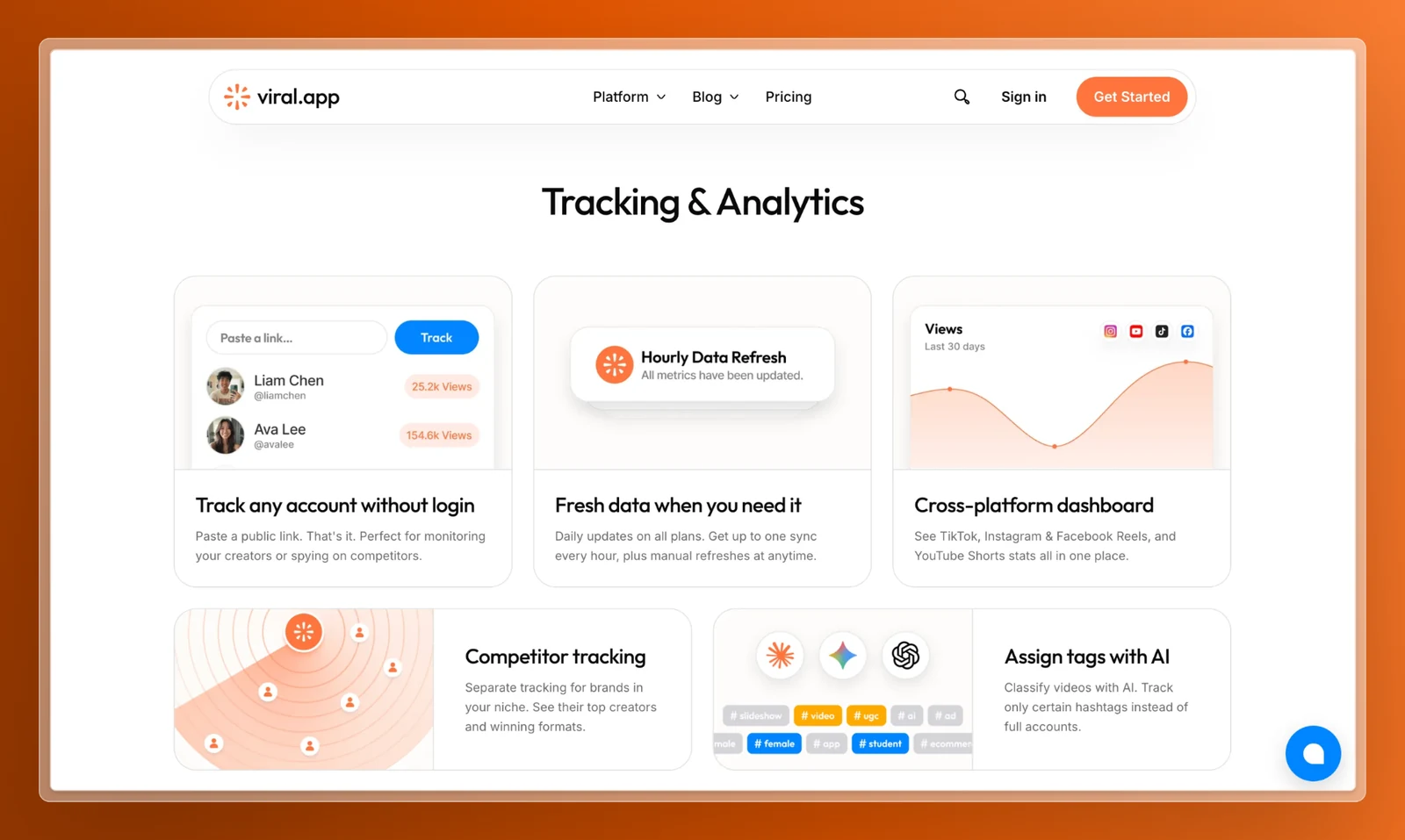
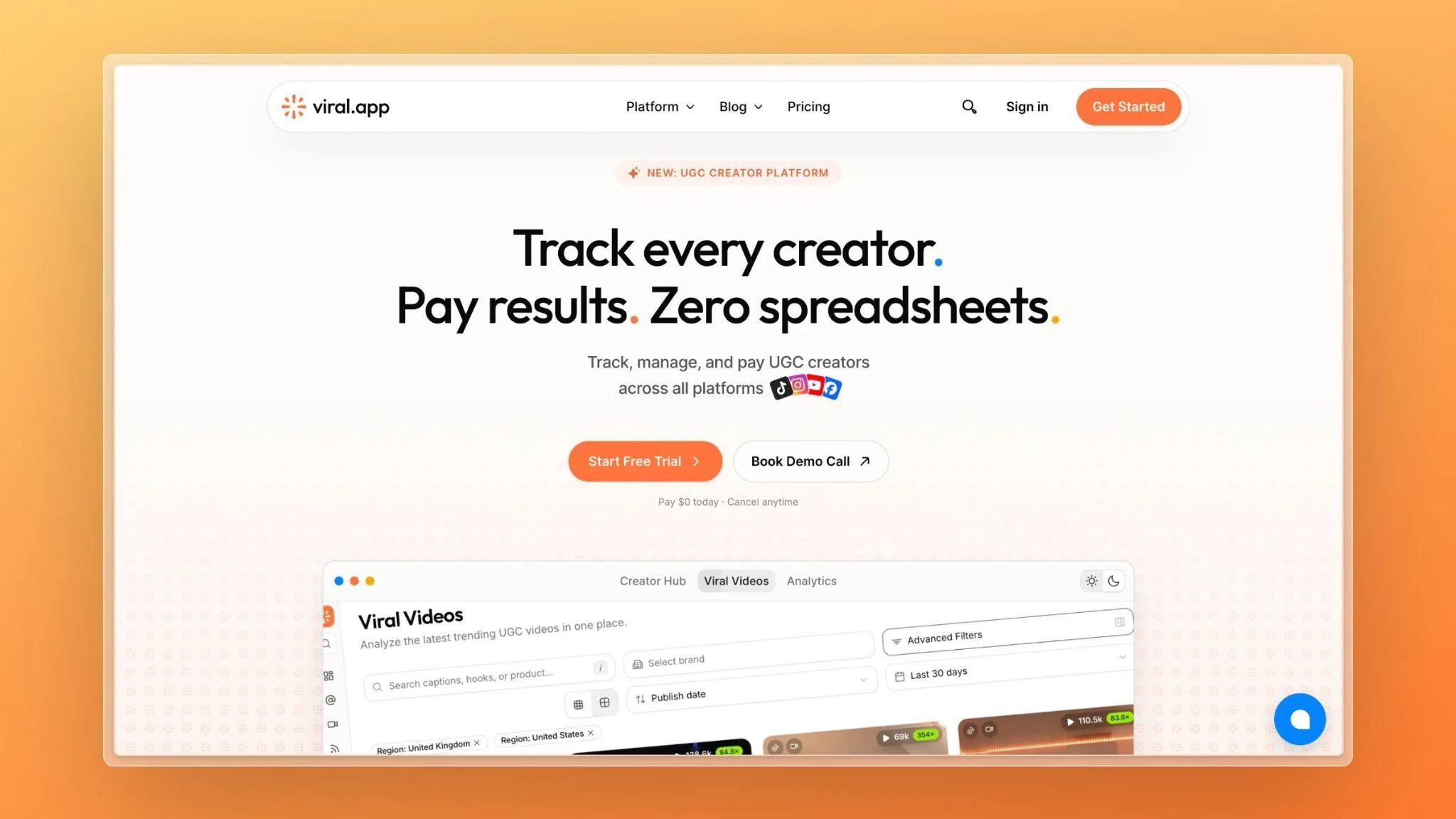
If your team works heavily with creators and short-form content, viral.app's UGC analytics platform stands out because it tracks campaigns across TikTok, Instagram Reels, YouTube Shorts, Facebook, and Snapchat Spotlight while also handling creator workflows and reporting.
viral.app is designed for short-form creator marketing and brings tracking, campaign management, and payouts into one place. It is often the right choice for UGC teams that care about having a scalable system, not just about views.
Marketing analytics tools at a glance
Pricing was checked against each vendor's public site on August 19, 2026. Plans and limits can change, so confirm the current package before buying.
The 9 best marketing analytics tools in 2026
1. viral.app — Best for UGC and short-form creator campaigns
Best for: Teams running high-volume creator programs across TikTok, Instagram Reels, YouTube Shorts, Facebook, and Snapchat Spotlight.
If your work is centered around Canvas UGC, viral.app is one of the best tools on this list. It is built for high-volume short-form creator marketing and brings tracking, campaign management, reporting, and payouts into one place.
What makes it useful is the focus. Instead of trying to be a broad business intelligence tool for every department, viral.app is designed around the day-to-day work of teams running Canvas UGC creator campaigns on social platforms.
It also tracks more than views and likes. With built-in attribution filters, ROI tracking, and campaign analytics, viral.app helps you connect content performance with business results.
Pricing snapshot: The public Pro plan starts at $79 per month when billed annually, and viral.app includes a 7-day free trial.
Pros
Built for short-form Canvas UGC and creator campaigns, not just general reporting.
Combines tracking, creator management, and payouts in one workflow.
Supports organic ROI tracking instead of stopping at views and engagement.
Connects creator and campaign performance to business results.
Cons
Best suited to short-form creator marketing, not broad company-wide analytics.
Less relevant if your main focus is SEO, email, or website-only reporting.
2. Domo — Best for cross-team business intelligence
Best for: Companies that need to combine marketing, sales, finance, and operations data in one reporting layer.
Domo is a better fit for teams that need one place to pull together data from many systems. The platform is known for real-time dashboards, strong integrations, and collaborative reporting across departments.
This is the kind of tool companies choose when they have outgrown simple dashboards and need to connect marketing, sales, and operations data in one reporting layer. It is powerful, but the trade-off is that setup can be more complex than with marketer-first tools.
Pricing snapshot: Domo offers a 30-day free trial and custom, credit-based pricing tied to usage.
Pros
Strong data integration across many sources.
Real-time dashboards are useful for teams that need frequent reporting updates.
Works well when multiple departments need to work from shared data.
Cons
Pricing is harder to predict than fixed monthly tools.
Setup and customization may require more time and expertise.
3. Google Analytics 4 — Best free web and app analytics tool
Best for: Teams that need a free starting point for website traffic, app behavior, conversions, and acquisition reporting.
Google Analytics 4 is still the default starting point for many teams because the free version covers a lot. It tracks website and app behavior with an event-based model and connects naturally with other marketing tools like Google Ads.
For many brands, GA4 is the easiest way to get a working analytics setup without paying for enterprise software. It is especially useful for traffic analysis, user behavior tracking, conversions, and cross-platform measurement.
The biggest weakness is usability. GA4 is powerful, but many marketers find it harder to learn than older analytics tools, and larger sites may run into limits that push them toward Analytics 360.
Pricing snapshot: The standard version is free. Google sells Analytics 360 through its enterprise sales motion.
Pros
Free entry point with strong core analytics features.
Good fit for website and app tracking.
Integrates well with Google's advertising and data ecosystem.
Cons
Can feel confusing for beginners.
Advanced needs may require the paid enterprise version.
4. Adobe Analytics — Best for enterprise customer journey analysis
Best for: Large organizations that need advanced segmentation, attribution, governance, and journey analysis across digital channels.
Adobe Analytics is built for larger companies with more advanced reporting needs. It is known for deep segmentation, detailed customer journey analysis, and enterprise-grade attribution.
This is not the lightest tool on the list, but that is also why some teams choose it. If a company needs control over data, flexible reporting, and tight links to the Adobe ecosystem, Adobe Analytics can do much more than a simple web analytics platform.
The trade-off is implementation complexity. Adobe Analytics is powerful but technical, with a steeper learning curve than simpler alternatives.
Pricing snapshot: Adobe does not publish simple self-serve pricing. Buyers need to book a demo or request a consultation.
Pros
Very strong segmentation and reporting depth.
Good fit for enterprise customer journey analysis.
Works especially well for companies already using Adobe Experience Cloud.
Cons
More technical than most marketer-first tools.
Setup usually takes more support and planning.
5. Mixpanel — Best for product and event analytics
Best for: SaaS companies, mobile apps, and product teams analyzing activation, engagement, retention, and drop-off.
Mixpanel is a strong choice for marketing teams that care more about user behavior than top-line traffic numbers. It is built around event-based tracking, which makes it useful for SaaS companies, mobile apps, and product teams that want to understand retention, engagement, and how people move through a product over time.
This is the kind of tool you use when pageviews are not enough. If your team wants to know which actions lead to activation, repeat use, or drop-off, Mixpanel gives you a much clearer picture than a standard website analytics platform.
Pricing snapshot: Mixpanel has a free plan, a usage-based Growth plan, and quote-based Enterprise pricing.
Pros
Good for event-based tracking and product analytics.
Strong retention and cohort reporting.
Useful when you need to measure what users do after sign-up or install.
Cons
Less useful for teams focused mainly on SEO, content, or traditional website reporting.
Better suited to apps and SaaS products than to simple inbound marketing sites.
6. Moz Pro — Best for straightforward SEO workflows
Best for: Small and growing teams that need keyword research, site audits, link analysis, and rank tracking in one platform.
Moz Pro is an SEO-focused platform that often feels more straightforward than larger all-in-one suites. It covers keyword research, site audits, link analysis, and rank tracking, which makes it a solid option for teams that want a cleaner SEO workflow.
For many marketers, the value of Moz Pro is keeping the core SEO tasks clear and manageable. It may not be as broad as some competitors, but it can be easier to work with if your goal is to improve rankings without building a very large search stack.
Pricing snapshot: Moz advertises an entry-level plan from $49 per month. Larger annual plans start from $79 per month, with a free trial available.
Pros
Useful for site audits, backlink analysis, and rank tracking.
Easier to navigate than some broader SEO platforms.
Good fit for teams that want solid SEO basics in one place.
Cons
Less broad than larger SEO suites.
Not the best choice if you want deep competitor research across many channels.
7. Kissmetrics — Best for lifecycle and retention analysis
Best for: Businesses that need person-level journey, attribution, retention, and churn insights.
Kissmetrics is focused on the customer journey rather than just traffic volume. It is designed to help marketing teams track user behavior, understand retention, and spot the points where customers lose interest or leave.
That makes it a good fit for businesses that care about lifecycle marketing and long-term customer value. Instead of only looking at sessions or clicks, Kissmetrics helps marketers connect actions to real people over time.
Pricing snapshot: Kissmetrics offers a free workspace for up to 100,000 events per month. The Growth plan starts at $99 per month, or $79 per month on the annual basis shown publicly.
Pros
Helpful for customer journey mapping and churn analysis.
Gives teams a more user-level view of behavior.
Works well for retention-focused marketing.
Cons
Not the best fit if your main need is basic website traffic reporting.
More useful for teams that already know retention is a key business goal.
8. Crazy Egg — Best for heatmaps and conversion research
Best for: Marketing and CRO teams improving landing pages through heatmaps, recordings, surveys, and A/B tests.
Crazy Egg is one of the simplest tools on this list, and that is part of the reason people like it. It focuses on heatmaps, scroll maps, session recordings, and A/B testing, which makes it practical for landing page work and conversion rate optimization.
This is a useful tool for discovering what people actually do on a page. It will not replace a full analytics platform, but it can make website changes easier because the data is visual and easy to use.
Pricing snapshot: Crazy Egg offers a free plan and a 30-day free trial. Paid pricing depends on tracked pageviews, recordings, and related usage limits.
Pros
Easy to understand and quick to set up.
Strong for heatmaps, scroll depth, and page testing.
Useful for improving landing pages and user experience.
Cons
Narrower scope than full marketing analytics platforms.
Best used alongside another tool, not on its own.
9. Semrush — Best for SEO and competitive analysis
Best for: Content teams, SEO specialists, and agencies connecting search strategy with competitor research and content planning.
Semrush is one of the strongest options for marketing teams that care about organic growth. It combines keyword research, backlink analysis, content auditing, and competitor research, helping marketers understand both their own search performance and what others in the market are doing.
It is especially useful for content teams, SEO specialists, and brands that want to connect search strategy with content planning. If search is a major channel for your business, Semrush can answer questions that a general dashboard tool cannot.
Pricing snapshot: Semrush's SEO plan starts at $139 per month, or $117.33 per month when billed annually. Higher plans add AI visibility, historical data, more projects, and larger limits.
Pros
Strong keyword and competitor data.
Helpful for SEO strategy and content planning.
Good all-in-one option for search-focused teams.
Cons
Can feel heavy if you only need one or two SEO features.
The amount of data can be a lot for smaller teams.
Which marketing analytics tool should you choose?
You do not need the biggest analytics platform to get better at marketing. You need the right marketing analytics tool for your current priorities.
Map your main goals, pick one core analytics platform, and then add specialist tools for SEO, attribution, UX, or creator tracking. A clear reporting framework also makes it easier to decide what each tool needs to contribute.
For teams that work heavily with creators and short-form content, that core tool is often the one that connects campaigns, payouts, and ROI in one place, which is exactly where viral.app fits. You can check the fit on a live campaign with a 7-day free trial and cancel anytime. For a deeper comparison of UGC-specific options, see the best UGC analytics tools ranking or the broader UGC marketing tools roundup.
Frequently asked questions
viral.app is the most relevant option for UGC and creator-led short-form campaigns because it combines tracking, reporting, campaign workflows, payouts, and ROI visibility in one platform.
Google Analytics 4 is the strongest free starting point for website and app analytics. Mixpanel, Kissmetrics, and Crazy Egg also offer free entry points for narrower product, lifecycle, or conversion-research jobs.
Semrush and Moz Pro are the best fits in this list if your main focus is organic search and content performance. Semrush is broader, while Moz Pro can feel more straightforward for core SEO workflows.
Usually. Most teams use one core analytics platform and then add specialist tools for SEO, attribution, user experience, product behavior, or creator tracking. The right combination depends on the decisions your team needs the data to support.