A practical ranking of 12 UGC analytics platforms for teams tracking TikTok, Instagram Reels, YouTube Shorts, creator campaigns, social reporting, listening, attribution, and revenue performance.
Written by
PublishedApril 22nd, 2026
UpdatedSeptember 18th, 2026
Most UGC analytics lists mix three different problems together: tracking videos, finding creators, and reporting social performance. Those jobs overlap, but they do not need the same tool.
A small app team may need to know which creator's TikTok, Reel, or Short drove installs this week. An agency may need white-label reports for clients. An ecommerce team may care more about rights, shoppable galleries, or revenue attribution. A brand team may want social listening because the best UGC is not always tagged.
This guide compares viral.app, Exolyt, Storyclash, Iconosquare, Social Status, Brand24, Dash Social, Pixlee, HypeAuditor, Metricool, Sprout Social, and Admetrics around the buyer question that matters: what do you need UGC analytics to trigger next?
This ranking is about analytics depth. If you are shopping for the broader stack — creator sourcing, content production, social proof, and AI video — see our separate roundup of the best UGC marketing tools instead.
Quick answer
viral.app is the best overall UGC analytics tool for teams that need short-form analytics, creator campaign operations, and performance-based payouts in one workspace. The other tools are useful when the job is narrower: TikTok research, creator discovery, social reporting, listening, commerce attribution, or enterprise social management.
How we evaluated these UGC analytics tools
We weighted the ranking around practical buyer criteria:
short-form coverage across TikTok, Instagram Reels, and YouTube Shorts
per-video and per-creator analytics depth
creator campaign workflows
payout and finance support
reporting quality for stakeholders or clients
social listening, UGC discovery, and rights workflows
pricing clarity and team fit
integration depth, including API, CSV, automation, and agent workflows
A tool can be excellent and still be wrong for your workflow. TikTok-only analytics, ecommerce UGC galleries, and enterprise social suites solve different jobs.
UGC analytics tools at a glance
How to choose before reading every review
Start with the workflow you need to improve:
Choose viral.app if short-form analytics need to connect to creator rosters, campaign status, reporting, payout rules, invoices, APIs, and automation.
Choose Exolyt if your team is TikTok-only and wants deeper TikTok research than a general social suite gives you.
Choose Storyclash if creator discovery and brand-fit search are more important than day-to-day campaign operations.
Choose Iconosquare if your main job is owned-channel analytics, publishing support, competitor benchmarks, and recurring social reports.
Choose Social Status if your agency needs polished reports more than a campaign operating system.
Choose Brand24 if the pain is discovering mentions, hashtags, untagged UGC, and brand conversations across the web.
Choose Dash Social if you are an enterprise brand with rights workflows, predictive scoring, and earned-media amplification needs.
Choose Pixlee if ecommerce revenue attribution from UGC matters more than short-form creator performance.
Choose HypeAuditor if you need to vet creators before a campaign starts.
Choose Metricool if budget matters more than UGC-specific depth.
Choose Sprout Social if your organization needs a broad enterprise social suite and can pair it with a UGC specialist where needed.
Choose Admetrics if your DTC ecommerce team needs marketing attribution, MMM, profit analytics, and budget optimization around paid and creator-driven growth.
The 12 best UGC analytics tools, ranked
Capability rubric used throughout:
Low = present lightly, unclear, or secondary
Medium = clearly supported, but not the main reason to buy the product
High = one of the clearer public strengths of the product
1. viral.app — Best overall UGC analytics platform
Best for: brands, app founders, and agencies that need short-form analytics, creator campaign operations, and performance-based payouts in one system.
viral.app ranks first because it connects analytics to the work that happens after a video posts.
A UGC team does not only need to know that a creator's TikTok reached 80,000 views. It needs to know which campaign that creator belongs to, whether the post should trigger a payout, which formats are repeating, which competitors are moving, and what finance should reconcile later.
viral.app is built around that operating layer:
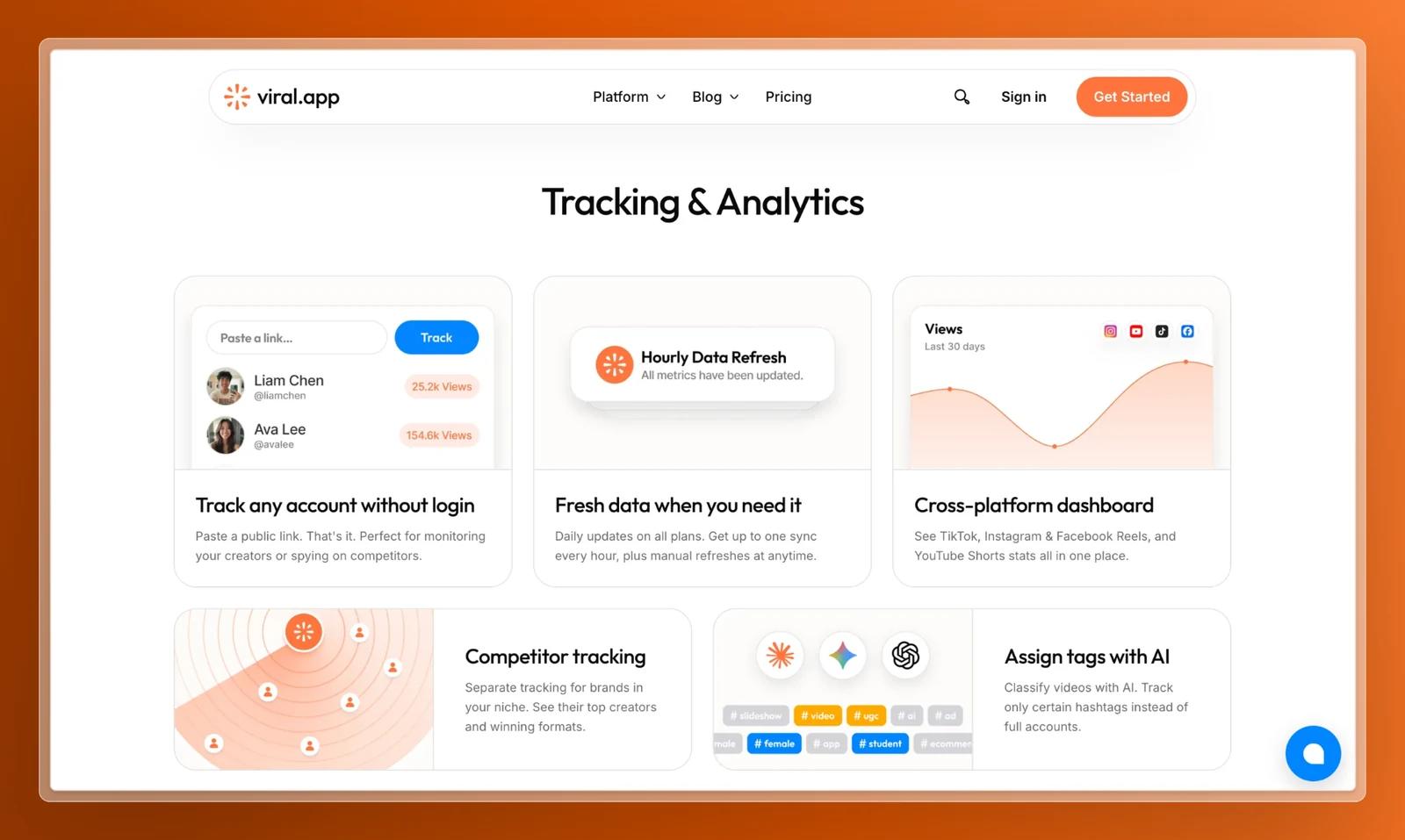
add accounts by pasting profile URLs
monitor recent videos across TikTok, Instagram Reels, YouTube Shorts, Facebook Reels, and Snapchat Spotlight
inspect per-video daily performance after the first sync
cluster content with AI video classification
track hashtags, competitors, and niches
hire creators through the built-in Canvas UGC marketplace: post jobs, review unlimited applications, chat with applicants
run unlimited campaigns with creator assignment
handle performance-based global payouts, invoicing, and tax workflows
export CSVs or connect through API, MCP, n8n, and OpenClaw
Supported features
Short-form analytics: high — TikTok, Reels, Shorts, Facebook Reels, and Snapchat Spotlight are the core surface.
Creator campaign ops: high — campaigns, creators, reporting, and payouts live together.
Payouts / finance: high — performance-based payouts are a central reason to choose it.
Social listening: low to medium — useful competitor and niche tracking, but not a broad web-listening suite.
Reporting / exports: high — CSV, API, client/stakeholder access, and automation surfaces are part of the platform story.
Creator discovery: medium to high — the built-in marketplace brings creators to you: post a job and applicants arrive with first-party profiles (portfolio videos, connected accounts, languages, location). Storyclash and HypeAuditor still hold larger influencer search databases.
Pricing snapshot
viral.app offers a 7-day free trial, then paid plans. The public buying motion is suited to teams that want to start quickly and expand into larger creator programs.
Where viral.app is strongest
one workspace for analytics, creators, campaigns, and payouts
creator marketplace where applicants come to you with vetting data already attached: portfolio videos, connected accounts, languages, and location
strong fit for teams publishing dozens or hundreds of creator videos per month
useful for app teams that need to connect short-form performance back to installs and campaign decisions
developer-friendly with API, MCP, CSV export, n8n, and agent-ready workflows
better system-of-record potential than analytics-only dashboards
Where viral.app is weaker
not meant to replace a broad web-monitoring suite like Brand24
not a TikTok-only forensic research tool like Exolyt
not the cheapest option for solo creators who only need basic social stats
Bottom line: viral.app is the best choice when UGC analytics need to run the creator program, not just decorate a report.
2. Exolyt — Best for TikTok-only analytics depth
Best for: teams that need detailed TikTok monitoring, trend research, hashtag analysis, comment sentiment, and competitor TikTok benchmarking.
Exolyt is the specialist in this list. If your whole UGC program lives on TikTok, that focus can be useful. The product is built for TikTok profiles, videos, hashtags, trends, sentiment, and competitive intelligence.
The tradeoff is scope. If your creators post the same campaign across Reels and Shorts, Exolyt will not be the full operating layer. You will need another system for cross-platform performance, creator management, and payouts.
Short-form analytics: high for TikTok, low for Reels and Shorts.
Creator campaign ops: low — it is more analytics and intelligence than campaign back office.
Payouts / finance: low — not the reason to buy it.
Social listening: medium — useful TikTok trend, hashtag, and sentiment context.
Reporting / exports: medium — useful for TikTok research and monitoring.
Creator discovery: medium — helpful for TikTok research, not a full influencer CRM.
Pricing snapshot
Exolyt has a free Basic plan with one tracked TikTok account. Paid plans are $400 per month for Essentials and $950 for Advanced on monthly billing (USD, checked September 18, 2026; Exolyt shows other currencies by country).
Where Exolyt is strongest
TikTok profile and video-level analytics
hashtag and trend tracking
sentiment analysis on comments
competitor TikTok benchmarking
Where Exolyt is weaker
no Reels or Shorts coverage as the main product promise
weaker fit when analytics must trigger creator payouts or campaign workflows
narrower than viral.app for teams running multi-platform UGC programs
Bottom line: Exolyt is a strong TikTok intelligence tool. It is not the best fit if your UGC program spans TikTok, Reels, Shorts, creators, campaigns, and payouts.
3. Storyclash — Best for content-based creator discovery
Best for: brands and agencies that want to find creators by what they post, how their content fits the brand, and whether they already produce relevant UGC.
Storyclash is strongest before the campaign starts. It uses AI to surface creators based on content, not follower count alone. That makes it useful for brands that care about creator-brand fit and want to search by the kind of videos people actually make.
Its analytics matter, but the main buying reason is discovery. If the campaign is already live and the hard part is tracking every post, assigning creators, and calculating payouts, viral.app is the more natural operating layer.
Supported features
Short-form analytics: medium — useful across creator content, but not the deepest per-video campaign OS.
Creator campaign ops: medium — supports campaign reporting, with discovery as the main wedge.
Payouts / finance: low — not a prominent reason to buy it.
Social listening: medium — useful earned media and UGC tracking.
Reporting / exports: medium — campaign reporting exists.
Creator discovery: high — the clearest reason to shortlist Storyclash.
Pricing snapshot
Storyclash uses custom pricing.
Where Storyclash is strongest
AI creator discovery across TikTok, Instagram, and YouTube
content-based brand-fit scoring
earned media and UGC tracking
useful shortlist building for agencies and brand teams
Where Storyclash is weaker
less focused on performance payout rules
less naturally a system of record for active creator campaigns
more discovery-led than analytics-led for teams already managing large rosters
Bottom line: Storyclash is a strong search-led discovery tool with a larger influencer database. viral.app answers “who should we work with?” from the opposite direction — post a job on its marketplace and creators apply with first-party profiles — and it stays the more natural operating layer for “what did every creator post, what worked, and what do we owe?”
4. Iconosquare — Best for owned social analytics and reporting
Best for: brand teams managing several owned social channels who need analytics, competitor benchmarks, scheduling support, and clean recurring reports.
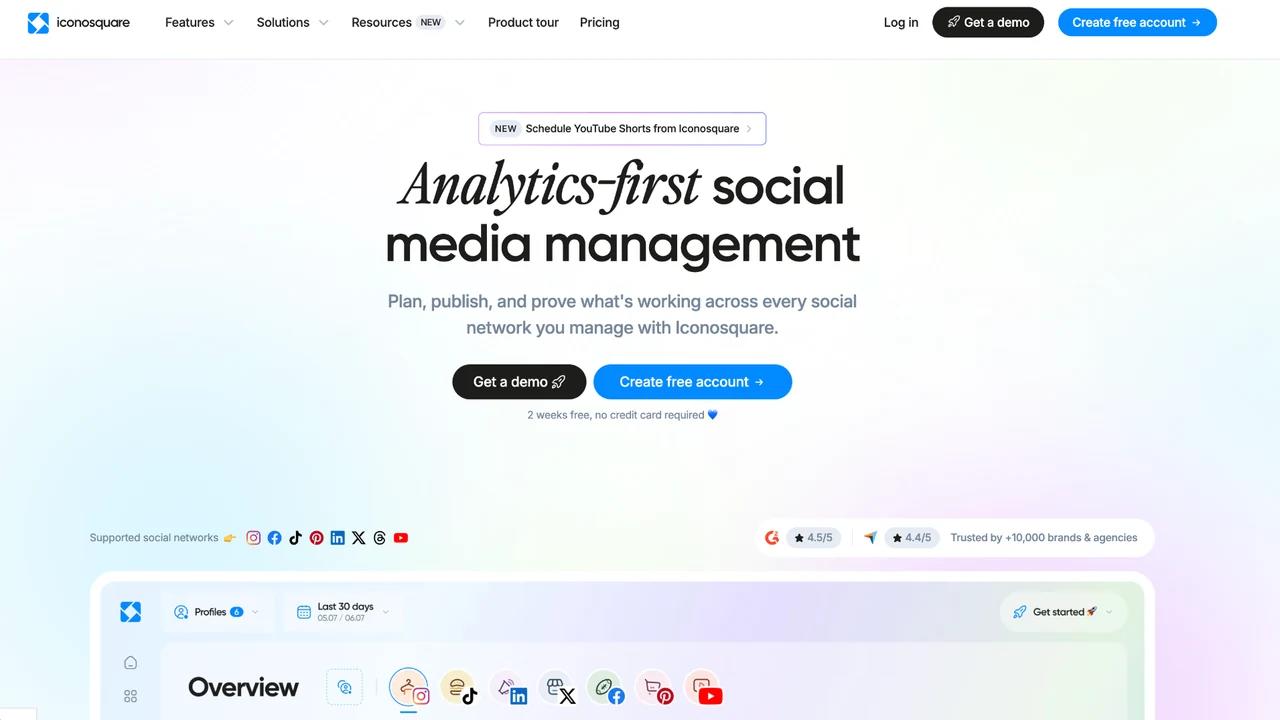
Iconosquare is a mature social analytics platform, not a UGC-native campaign operating system. That distinction matters.
If your team mainly tracks brand accounts, publishes social posts, compares competitors, and exports reports, Iconosquare is a sensible pick. If your workflow starts with creators and ends with payout reconciliation, it solves only part of the job.
Short-form analytics: medium to high — useful TikTok and Instagram analytics inside broader social reporting.
Creator campaign ops: low to medium — social campaigns, not creator payout operations.
Payouts / finance: low — not a core product workflow.
Social listening: medium — listening and competitor benchmarks help social teams.
Reporting / exports: high — reports and benchmarks are a major strength.
Creator discovery: low — not the main job.
Pricing snapshot
The UGC Analytics snapshot lists Iconosquare from around $299/month. Iconosquare also sells lower entry social-management plans on its own pricing page, so buyers should confirm the exact package that includes the reporting and benchmarking depth they need.
Where Iconosquare is strongest
multi-network owned-channel analytics
competitor benchmarking
custom and white-label reports
scheduling and listening add-ons
Where Iconosquare is weaker
not a creator roster or campaign payout system
less UGC-specific than viral.app
can be overkill if the only need is basic social stats
Bottom line: Iconosquare is a strong social analytics and reporting tool. It should not be mistaken for a performance UGC operating system.
5. Social Status — Best for agency reporting
Best for: agencies that need polished social reports across organic, paid, competitor, and influencer activity.
Social Status is built around reporting. If clients judge your work through monthly decks and recurring dashboards, that focus is valuable.
It is less useful as the center of a UGC program. Reporting tells you what happened. A creator campaign OS also needs assignments, status, payout logic, finance handoff, and a memory of which posts belonged to which brief.
Supported features
Short-form analytics: medium — supports major social networks including TikTok, Instagram, Facebook, YouTube, and X.
Creator campaign ops: low to medium — influencer reporting exists, but not full creator operations.
Payouts / finance: low — not the core product.
Social listening: medium — competitor and influencer reporting are part of the value.
Reporting / exports: high — the main reason to buy it.
Creator discovery: low — not positioned as a creator search platform.
Pricing snapshot
Social Status has paid plans and a free tier for small accounts.
Where Social Status is strongest
automated white-label PDF reports
organic, paid, competitor, and influencer reporting
scheduled client delivery
agency-friendly report production
Where Social Status is weaker
less depth for TikTok-only intelligence than Exolyt
less campaign operating depth than viral.app
reporting-first, not payout-first
Bottom line: Social Status is a strong agency reporting layer. Pair it with a dedicated UGC operating system if creators, campaigns, and payouts are the hard part.
6. Brand24 — Best for finding untagged UGC and brand mentions
Best for: teams that need to discover brand mentions, hashtags, and untagged UGC across social platforms, the web, news, and podcasts.
Brand24 answers a different question from most analytics tools here: what are people saying about us that we might otherwise miss?
That makes it useful for UGC discovery. Customers and creators do not always tag the brand cleanly. Brand24 can surface mentions, hashtags, and conversations that would not appear inside a normal account analytics dashboard.
The limitation is performance depth. Finding a mention is not the same as tracking every creator video inside a campaign.
Supported features
Short-form analytics: low to medium — useful for mentions, not deep per-video performance.
Creator campaign ops: low — not a campaign back office.
Payouts / finance: low — not part of the core workflow.
Social listening: high — the main reason to choose it.
Reporting / exports: medium — useful for monitoring and stakeholder context.
Creator discovery: medium — can reveal relevant mentioners and influencers.
Pricing snapshot
Brand24 starts from around $99/month.
Where Brand24 is strongest
real-time mention and hashtag monitoring
sentiment analysis
AI topic clustering and insights
broad coverage across social, web, news, and podcasts
Where Brand24 is weaker
not a per-video performance analytics system
not built around creators, campaigns, or payouts
works best alongside a dedicated UGC analytics platform
Bottom line: Brand24 is the best pick here when the main problem is discovering UGC you did not know existed.
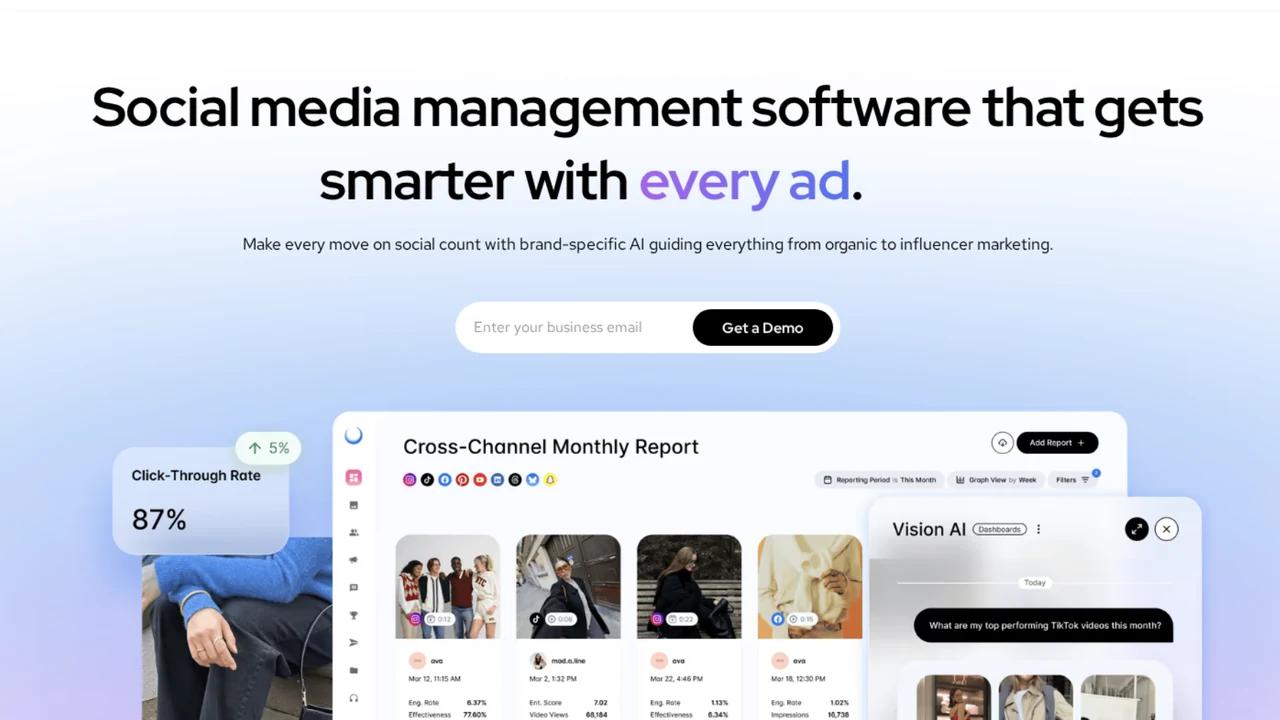
7. Dash Social — Best for enterprise earned UGC workflows
Best for: enterprise brands that want predictive content scoring, earned-media analytics, rights management, and amplification workflows.
Dash Social is an enterprise UGC and social platform. It is built for brand teams that need to evaluate content before publishing, manage rights, track earned media, and push UGC into larger social workflows.
That makes it credible for big consumer brands. It is also heavy for small UGC teams that mostly need creator tracking, short-form analytics, and performance payouts.
Supported features
Short-form analytics: medium to high — strong for Instagram and TikTok in an enterprise context.
Creator campaign ops: medium — good enterprise workflow, less centered on payout operations.
Payouts / finance: low — not the public wedge.
Social listening: medium — useful earned-media and content intelligence.
Reporting / exports: high — enterprise reporting is part of the value.
Creator discovery: medium — useful around earned UGC and brand content.
Pricing snapshot
Dash Social uses enterprise pricing. The UGC Analytics snapshot lists the Advance plan around $1,999/month.
Where Dash Social is strongest
predictive content scoring before publishing
UGC rights management
earned-media analytics
cross-channel publishing support
Where Dash Social is weaker
expensive for lean teams
heavier than many performance UGC programs need
less naturally focused on performance-based creator payouts
Bottom line: Dash Social is strong when enterprise UGC operations include rights, prediction, and amplification. viral.app is usually leaner when the central workflow is creator performance and payouts.
8. Pixlee — Best for ecommerce UGC revenue attribution
Best for: ecommerce brands that need to collect UGC, manage rights, publish shoppable galleries, and connect UGC exposure to revenue.
Pixlee is the ecommerce specialist. Its job is to connect customer and influencer content to commerce outcomes: rights, galleries, ambassador identification, and revenue attribution.
That is a valuable UGC problem, but it is not the same as short-form campaign analytics. If your KPI is on-site conversion from shoppable UGC, Pixlee belongs on the list. If your KPI is creator video performance across TikTok, Reels, and Shorts, start elsewhere.
Supported features
Short-form analytics: medium — useful around Instagram, TikTok, and UGC assets.
Creator campaign ops: medium — good for ambassador and commerce workflows, not performance payout ops.
Payouts / finance: low — not the main product story.
Social listening: medium — content collection and rights workflows matter.
Reporting / exports: medium to high — strong when revenue attribution is the metric.
Creator discovery: medium — ambassador and creator identification help ecommerce teams.
Pricing snapshot
Pixlee uses custom pricing.
Where Pixlee is strongest
UGC collection and rights management
shoppable on-site UGC galleries
ambassador and creator identification
conversion and revenue attribution
Where Pixlee is weaker
less suited to pure creator performance analytics
less focused on TikTok/Reels/Shorts campaign operations
not the natural choice for performance-based payout workflows
Bottom line: Pixlee is best when UGC needs to prove ecommerce revenue. It is less direct when the team needs to run high-volume short-form creator campaigns.
9. HypeAuditor — Best for creator vetting and audience authenticity
Best for: teams that need to check audience quality, detect fake followers, and vet creators before spending campaign budget.
HypeAuditor helps answer the uncomfortable question before a campaign starts: is this creator's audience real enough to justify the spend?
That makes it valuable for influencer marketing and creator selection. It is not the same as post-level performance tracking after a UGC campaign goes live. Most teams that use it for vetting still need another system for live campaign analytics, creator assignments, and payouts.
Supported features
Short-form analytics: medium — useful for TikTok, Instagram, and YouTube creator evaluation.
Creator campaign ops: medium — campaign tracking exists, but vetting is the stronger reason to buy.
Payouts / finance: low — not the main workflow.
Social listening: low to medium — creator analytics rather than broad listening.
Reporting / exports: medium — good for influencer analysis and evaluation.
Creator discovery: high — especially when audience quality matters.
Pricing snapshot
HypeAuditor has paid plans with custom pricing.
Where HypeAuditor is strongest
audience-quality scoring
fake-follower and authenticity analysis
engagement-quality checks
creator discovery and ranking
Where HypeAuditor is weaker
more creator-vetting than performance analytics
less useful once the core problem is operating live creator campaigns
does not replace a UGC campaign system of record
Bottom line: HypeAuditor is a strong pre-campaign vetting tool for auditing audience quality at database scale. On viral.app, marketplace applications arrive with first-party vetting data built in — portfolio videos, connected accounts, languages, location — and the same workspace then runs live tracking and payouts.
10. Metricool — Best budget UGC analytics option
Best for: solo creators and small teams that need affordable multi-platform analytics, scheduling, and basic competitor tracking.
Metricool is the budget pick. It covers many networks, has a generous free plan, and gives small teams enough analytics and scheduling to get organized.
The tradeoff is depth. Metricool is a generalist. It will not match the creator campaign operations, payout workflows, or short-form UGC depth of a specialist platform. That is fine if price is the constraint.
Supported features
Short-form analytics: medium — useful across TikTok, Instagram, YouTube, and more.
Creator campaign ops: low — not built as a creator campaign OS.
Payouts / finance: low — not part of the product story.
Social listening: low to medium — competitor tracking exists, broad listening is not the core.
Reporting / exports: medium — solid for the price.
Creator discovery: low — not the reason to buy it.
Pricing snapshot
Metricool has a limited free plan, with paid plans from around $22/month.
Where Metricool is strongest
low-cost multi-platform analytics
scheduling and publishing
competitor tracking
ads and SmartLinks analytics
Where Metricool is weaker
less UGC-specific than the leaders on this list
not built for creator payout workflows
lighter analytics depth than dedicated UGC tools
Bottom line: Metricool is excellent value for small teams. Serious UGC programs will outgrow it once campaign operations and payout rules matter.
11. Sprout Social — Best enterprise social management suite
Best for: large brands and agencies that want one mature suite for publishing, analytics, listening, inbox workflows, CRM, and stakeholder reporting.
Sprout Social is the broad enterprise default. It is mature, trusted by large teams, and covers a lot: publishing, analytics, listening, inbox, CRM workflows, competitor benchmarking, and reports.
That breadth is useful when the social team needs one suite. It can also be a mismatch for UGC-heavy programs. A broad social suite will not automatically give you creator rosters, payout rules, and post-level campaign finance.
Supported features
Short-form analytics: medium to high — strong inside a broad social analytics suite.
Creator campaign ops: low to medium — useful social workflows, not UGC payout operations.
Payouts / finance: low — not part of the public core workflow.
Social listening: high — a major reason to choose Sprout Social.
Reporting / exports: high — mature enterprise reporting.
Creator discovery: low to medium — social and listening data can help, but discovery is not the main wedge.
Pricing snapshot
Sprout Social starts from around $249/month per user.
Where Sprout Social is strongest
cross-network analytics and reporting
social listening
competitor benchmarking
publishing, inbox, and CRM workflows
Where Sprout Social is weaker
expensive per seat
not UGC-specific
often needs a specialist tool beside it for creator campaign operations
Bottom line: Sprout Social is the broadest enterprise social suite in this list. For performance UGC, it works better beside a specialist platform than as the whole system.
12. Admetrics — Latest addition for DTC ecommerce marketing analytics
Best for: DTC ecommerce brands that need marketing analytics, attribution, marketing mix modeling, and profit control around paid media and creator-driven growth.
Admetrics is a better fit when the analytics question is broader than creator post performance. Its
public positioning centers on DTC ecommerce marketing
analytics: real ROAS, CAC, CLV, marketing mix modeling, server-to-server data pushback,
and budget optimization across channels like Meta, Google, TikTok, Shopify, marketplaces, and
retention tools.
That makes it relevant for teams where influencer or UGC spend needs to be evaluated beside the rest of the media mix. It is less of a creator campaign operating system than viral.app, but stronger when the buyer needs profit-level marketing analytics and attribution across commerce data, ad platforms, and sales channels.
Supported features
Short-form analytics: low to medium — useful when TikTok or creator spend sits inside the broader marketing mix.
Creator campaign ops: low — not positioned as a creator roster, campaign assignment, or payout workflow.
Payouts / finance: low for creator payouts, medium for profit and business-performance analytics.
Social listening: low — not the main product story.
Reporting / exports: high — BI, 150+ KPIs, attribution, MMM, and performance reporting are core strengths.
Creator discovery: low — not the reason to buy it.
Pricing snapshot
Admetrics promotes demo-led buying, a 21-day free trial, and a free marketing data audit.
Where Admetrics is strongest
DTC ecommerce profit analytics
attribution and marketing mix modeling
ROAS, CAC, CLV, and LTV analysis
budget optimization across paid channels
connecting marketing, sales, Shopify, marketplace, and retention data
Where Admetrics is weaker
not a creator campaign system of record
not focused on creator assignments, deliverables, or payout approvals
less direct if your main question is which creator post performed best across TikTok, Reels, and Shorts
Bottom line: Admetrics is the latest addition for DTC ecommerce teams that need profit-level marketing analytics around creator and paid-media spend. Pair it with a UGC operating system when creators, campaign status, and payouts also need a dedicated workflow.
Pricing and packaging takeaways
Three patterns show up across the list.
1. Cheap tools are usually generalists
Metricool is affordable because it solves broad social analytics and scheduling for many users. That is useful. It also means it is not trying to own creator payouts, campaign finance, or multi-creator UGC operations.
2. Specialist tools are strongest when the job is narrow
Exolyt wins on TikTok depth. HypeAuditor wins on audience quality. Brand24 wins on mention discovery. Pixlee wins on ecommerce attribution. Those are real advantages when the buyer has one clear gap.
3. UGC operating systems need more than analytics
For high-volume UGC, the analytics screen is only the start. Someone still has to assign creators, check posts, compare briefs, report to stakeholders, calculate payouts, handle invoices, and make sure the next campaign learns from the last one.
That is where viral.app has the clearest advantage.
What to verify before buying a UGC analytics tool
Before you commit, ask these questions:
1
Name the object you measure
Creator posts, owned social accounts, brand mentions, and ecommerce revenue all point to different tool categories.
2
Test the post-to-report handoff
Check whether videos, creator records, campaign status, exports, and payout data can move without spreadsheet cleanup.
3
Add specialists only where they solve a gap
Listening, creator vetting, and commerce attribution can sit beside the core UGC analytics workflow when the need is specific.
1. Which platforms do we actually need?
TikTok-only teams can buy differently from teams that need TikTok, Reels, and Shorts in one place.
2. Does analytics need to trigger work?
If performance data should trigger follow-ups, approvals, reporting, or payouts, choose a tool that owns more than the dashboard.
3. Are we measuring creators, brand accounts, mentions, or revenue?
Those are different objects. viral.app starts with creators and short-form campaign performance. Brand24 starts with mentions. Pixlee starts with ecommerce UGC revenue. Iconosquare and Sprout Social start with owned social channels.
4. Do we need pre-campaign vetting or live campaign tracking?
HypeAuditor and Storyclash help when you want to search and audit a large influencer database. viral.app covers the pre-campaign step with its marketplace — creators apply to your jobs with portfolio videos, connected accounts, languages, and location — and then tracks performance and payouts once they post.
5. Can we export or connect the data?
CSV, API, MCP, n8n, and stakeholder access matter when analytics needs to move into finance, BI, client reporting, or agent workflows.
Final verdict
These products win in different ways:
viral.app wins on short-form UGC analytics connected to creator campaigns and payouts
Exolyt wins on TikTok-specific analytics depth
Storyclash wins on AI creator discovery by content fit
Iconosquare wins on owned social analytics and reporting
Social Status wins on agency reporting workflows
Brand24 wins on mention monitoring and untagged UGC discovery
Dash Social wins on enterprise earned UGC and rights workflows
Pixlee wins on ecommerce UGC revenue attribution
HypeAuditor wins on creator vetting and audience authenticity
Metricool wins on low-cost general social analytics
Sprout Social wins on broad enterprise social management
Admetrics wins on DTC ecommerce marketing attribution and profit analytics
If your team only needs one of those narrow jobs, buy the specialist. If your team needs to run a serious UGC program across creators, campaigns, analytics, and payouts, viral.app is the best place to start.
Ready to track UGC without another spreadsheet?
If your team wants one workspace to hire creators through the built-in marketplace, track their short-form performance, monitor competitors, and run performance-based payouts, start with viral.app and post your first job.
Questions & Answers
viral.app is the best overall UGC analytics tool for teams that need short-form analytics, creator campaign operations, and performance-based payouts in one workspace. It is strongest when analytics needs to connect to workflows instead of stopping at a dashboard.